Turkish pepper paste (biber salçası): hot, sweet and homemade
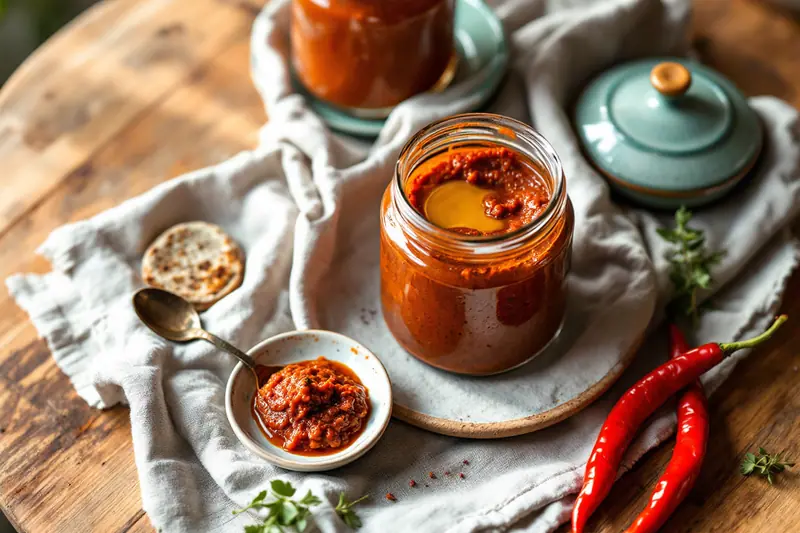
If you open a fridge in almost any Turkish home, there will be a jar of something thick and dark red near the front. It might be tomato paste, but more often, especially in families with roots in the south or south-east, it is biber salçası, red pepper paste. It is the quiet backbone of a huge amount of everyday cooking: the reason kısır is red, the warmth in a pot of beans, the sweet depth under a bulgur pilaf. A spoonful changes a dish more than any spice in the cupboard.
I grew up in İzmir, where tomato paste ruled the kitchen and pepper paste arrived in jars from relatives further east. Here in Lisbon, the markets fill with long red peppers at the end of summer, and that is when I make a small batch of my own. This piece covers what pepper paste is, the hot and sweet kinds, how it is traditionally made, how to cook with it so it tastes right, a home method that fits in an ordinary kitchen, and what to reach for when the jar is empty.
What biber salçası is
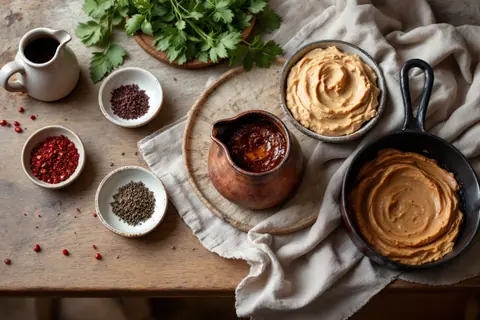
Pepper paste is red peppers, salt and time. That is all. Ripe red peppers are trimmed, minced to a pulp, salted and slowly reduced until most of their water has gone and what is left is a thick, glossy, concentrated paste. The result is sweet, savoury, salty and, depending on the peppers, gently or seriously hot.
It is much thicker and darker than a fresh pepper sauce, and it is not a chilli sauce at all. Even the hot kind is mostly about the deep cooked flavour of ripe pepper, with heat as a second note. Think of it as a cousin of tomato paste, made with peppers.
Hot or sweet?
You will see two main kinds: tatlı (sweet) and acı (hot). Many families also make a mix of the two.
Sweet pepper paste is made from mild red peppers. It is fruity and rounded, with a slight bitterness at the edge from the long cooking, and no real heat. It is the one to use for children, for gentle dishes and when you want colour and depth without fire.
Hot pepper paste includes hot peppers in the mix, sometimes with their seeds. The heat varies a lot from jar to jar and family to family. Some hot pastes have a warmth you notice only on the second spoonful; others are properly fiery. Taste a small amount on the tip of a spoon before cooking with a new jar.
If you are buying only one, buy the sweet one. You can always add heat with pul biber, the red pepper flakes that sit on every Turkish table. You cannot take heat out.
How it is made in late summer
In the towns and villages of the south and south-east, pepper paste is a late-summer job, done when the peppers are at their ripest and cheapest and the sun is still strong. It is often a family or neighbourhood event, with crates of peppers bought in one go and several days of work.
The peppers are washed and the stems and seeds are cut out. They are then put through a mincer into a thick red pulp and mixed with salt. In the traditional method, the pulp is spread out thinly on large shallow trays and set out on flat roofs, balconies and courtyards in full sun, covered with fine cloth to keep insects and dust off. Several times a day someone goes up and stirs each tray so it dries evenly and does not form a crust. Over many days, the colour darkens from bright red to deep brick, and the pulp thickens until a spoon stands up in it.
Some families start the process by boiling the pulp down in large pots over a fire, then finish it in the sun. Either way, the paste is packed into jars, pressed down to push out air, and covered with a layer of olive oil before the lids go on. Those jars are meant to last until the next late summer.
Cooking with pepper paste
The one rule: fry it before you add liquid. Raw pepper paste stirred straight into water tastes flat and slightly sour. Fried in oil or butter for a minute or two, it darkens, smells sweet and roasted, and gives the dish its proper depth. Turkish cooks call this salçayı kavurmak, and you will see it in nearly every recipe on this site that uses paste.
Here is how I do it. Soften the onion in oil, push it to one side, drop the paste into the clear patch of hot oil, and stir it there for a minute until it loosens, darkens a shade and the oil turns red. Then stir everything together and carry on. Keep the heat at medium. Pepper paste has natural sugars and can catch and turn bitter if the pan is too hot.
Pepper paste is salty. When you add a tablespoon of it to a dish, cut back the salt by about 1/2 teaspoon, then taste at the end.
Where it goes
- Into bulgur: rubbed into warm soaked bulgur for kısır, or fried with onion at the start of a pilaf.
- Into köfte: kneaded into the bulgur for meatless çiğ köfte, where it gives both colour and flavour.
- Into pulses: a spoonful with tomato paste in kuru fasulye, the white bean stew, or in ezogelin soup.
- Into breakfast: a little in menemen, or stirred into butter for eggs.
- Into dips and spreads: mashed with walnuts, breadcrumbs and pomegranate molasses, or simply mixed into thick yogurt with garlic.
- Into marinades: loosened with olive oil, garlic and a little lemon, and rubbed over chicken or vegetables before grilling.
Pepper paste and its neighbours
These are the red things in a Turkish pantry that people mix up most often. They overlap, but they are not the same.
| Sweet pepper paste | Hot pepper paste | Tomato paste | Pul biber | İsot | |
|---|---|---|---|---|---|
| Made from | Mild red peppers, salt | Mild and hot red peppers, salt | Tomatoes, salt | Dried red peppers, flaked | Dried, sweated red peppers, flaked |
| Form | Thick paste | Thick paste | Thick paste | Coarse flakes | Dark, moist flakes |
| Heat | None to faint | Mild to strong | None | Medium | Mild to medium, slow |
| Taste | Sweet, fruity, roasted | Sweet, roasted, warm | Bright, sour-sweet | Fruity, warm | Smoky, raisin-like |
| Colour | Deep brick red | Deep brick red | Bright red | Bright red | Dark purple to black |
| Main use | Base flavour and colour | Base flavour with heat | Base flavour, acidity | Seasoning, finishing | Finishing, köfte |
Many recipes use pepper paste and tomato paste together, usually in equal amounts. The tomato brings acidity and brightness, and the pepper brings sweetness and body.
A small home batch
You do not need a roof or a week of sunshine. This method reduces the peppers on the hob and finishes them slowly in a low oven, which gives a paste very close to the sun-dried kind. It makes one jar, which in my kitchen lasts a couple of months.
Use long red peppers if you can find them, or red bell peppers. Add a few hot red chillies for a hot paste, or leave them out for a sweet one.
Recipe
Homemade red pepper paste (ev yapımı biber salçası)
About 300 g, roughly 20 tablespoons
- Prep
- 30 min
- Cook
- 3 hr 30 min
- Total
- 4 hr
Paste
- 2 kg2 kg ripe long red peppers or red bell peppers
- 3 to 53 to 5 hot red chillies, for a hot paste, optional
- 1 tbsp15 g fine sea salt
- 3 tbsp45 ml olive oil, to seal the jar
Method
- Wash and dry the peppers, cut out the stems, seeds and pale ribs, and chop the flesh roughly. Do the same with the chillies if using, keeping some seeds for extra heat.
- Blend the peppers in batches to a smooth purée without adding water.
- Pour the purée into a wide, heavy, non-aluminium pan, stir in the salt and bring to a simmer over medium heat.
- Cook uncovered for 50 to 60 minutes, stirring every few minutes and more often towards the end, until it has reduced by about half and is as thick as a loose ketchup.
- Heat the oven to 120°C (250°F). Spread the reduced purée over a baking tray lined with baking paper in a layer about 1 cm deep.
- Bake for 2 to 2 1/2 hours with the door propped open a crack with a wooden spoon, stirring and spreading the paste out again every 20 to 30 minutes.
- It is ready when it is a deep brick red, glossy and thick, and a spoon drawn through it leaves a clean trench that does not fill back in.
- Let it cool, then pack it into a clean, dry jar, pressing it down to remove air pockets.
- Smooth the top, pour over a thin layer of olive oil to cover the surface, close the lid and keep in the fridge.
Cook's notes
- Always take paste out with a clean, dry spoon, smooth the surface and top up the oil after each use.
- Freeze some in an ice-cube tray, one tablespoon per cube, for longer keeping.
What the numbers look like
Peppers are mostly water, so the loss is dramatic. Two kilos of whole peppers give about 1.6 kg of trimmed flesh after stems, seeds and ribs come out. The hob stage takes that down to roughly 700 to 800 g, and the oven stage to about 300 to 350 g of finished paste. In other words, each tablespoon in the jar is the essence of around 100 g of fresh pepper. That is why a single spoonful does so much in a pot, and why the homemade version is worth the time when peppers are cheap.
Storing pepper paste
Homemade or bought, keep opened pepper paste in the fridge with a thin layer of olive oil over the top. Use a clean, dry spoon every time; a wet or oily spoon brings in the moulds that spoil a jar. Smooth the surface after you take some out and add a little more oil if the paste shows through.
Kept like this, a jar lasts for a couple of months. If a spot of mould appears on the surface, the safest thing is to throw the jar away rather than scrape it off. For long keeping, freeze it in tablespoon portions in an ice-cube tray, then tip the cubes into a bag. They go straight from the freezer into the hot oil in the pan.
What to use if you have none
None of these is quite the same, but each will get a dish close.
Roasted red peppers from a jar are the nearest. Drain them well, blend them smooth, and cook the purée in a small pan, stirring, until it is thick and has reduced by more than half. Two large roasted peppers give roughly two tablespoons of paste.
Tomato paste with paprika is the quickest. For each tablespoon of pepper paste, use one tablespoon of tomato paste mixed with one teaspoon of sweet paprika, plus a pinch of chilli flakes for a hot version. It is sharper and less sweet, so a pinch of sugar helps.
Ajvar, the Balkan red pepper relish, works well in stews and spreads, though it is looser and often contains aubergine (eggplant). Use about twice as much and cook it down a little longer.
Harissa is spicier and flavoured with cumin, caraway and garlic, so it changes the character of a dish. Use half the amount and expect a North African note.
When the peppers turn deep red in the market and the price drops, that is the signal. Buy two kilos, clear an afternoon, and by evening you will have a jar on the top shelf of the fridge with a film of green olive oil over the red.
Filed under Kitchen Notes

Bora is from İzmir and cooks the Aegean way: olive oil, vegetables, herbs and a table full of mezes. He lives in Lisbon, shops at the market most mornings and writes about dolma, salads and dishes served at room temperature.