
Menemen: Turkish eggs with tomatoes and green peppers
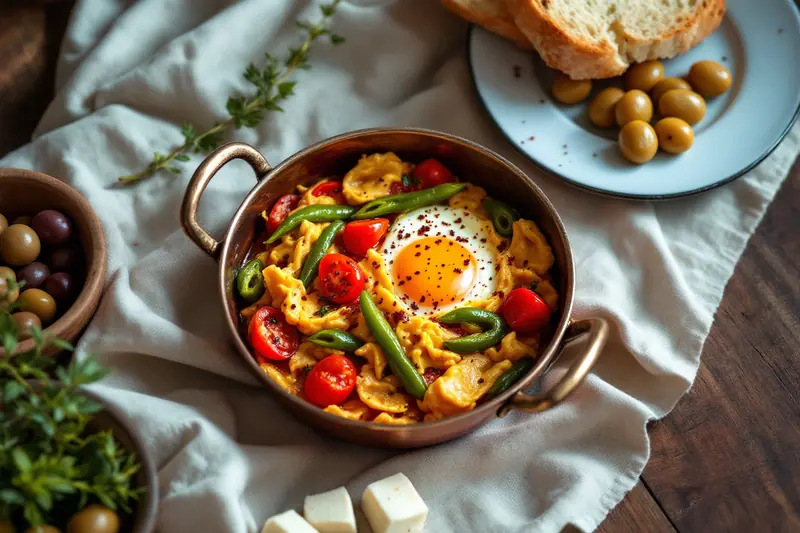
Menemen is what happens on a Turkish weekend morning when there are ripe tomatoes, a few long green peppers and a box of eggs. The peppers soften in oil, the tomatoes cook down into a thick, sweet sauce, and the eggs are folded through at the very end so they stay soft and glossy. It goes to the table in the pan it was cooked in, everybody tears off bread and dips in, and nobody uses a plate.
It is simple, which means the details matter. I have eaten a lot of disappointing menemen in my life: watery ones, rubbery ones, ones that tasted of raw pepper. Almost always the fault is the same, and it is impatience with the tomatoes. Cook them down properly and you are nine tenths of the way there.
In my family in Gaziantep, menemen was a summer dish, made when tomatoes were so ripe they split on the windowsill. Here in Bristol I make it all year, and I will tell you how to get a good result in February too.
What goes in, and why
The classic menemen has four things: green peppers, tomatoes, eggs and fat. Salt, of course, and usually a pinch of pul biber on top. Everything else is a family variation.
The peppers should be the long, thin, pale green Turkish ones called sivri biber, or their sweeter cousins, çarliston peppers. They have thin skins, a fresh grassy taste and only a little heat. If you cannot find them, use a mix of one green bell pepper and one or two mild green chillies, or the long pale peppers sold for frying in many shops. Avoid using only bell pepper; its thick skin and strong flavour take over.
The tomatoes need to be ripe and red right through. In summer, use whatever is reddest and softest at the market. In winter, supermarket tomatoes are mostly pale and watery, and I would rather use a good tin of chopped tomatoes with a teaspoon of Turkish pepper paste stirred in for depth. Tinned tomatoes need a few extra minutes to cook off their tinny sharpness.
For fat, I use olive oil and a knob of butter together. The oil carries the peppers, the butter adds richness at the end. All olive oil is fine and makes it lighter; all butter is very good but heavier.
Peel the tomatoes. Yes, really
Tomato skins curl into tough little rolls in menemen and catch in your teeth. There are two easy ways to avoid them.
The first: cut a cross in the base of each tomato, drop them into boiling water for 30 seconds, then into cold water. The skins slip off. Chop the flesh roughly.
The second, which I use more often: halve the tomatoes across and grate the cut side on the large holes of a box grater, pressing gently, until only the flat skin is left in your hand. You get a coarse pulp with no skin. It is quick, and it cooks down faster than chopped tomato.
Some people like small chunks of tomato in their menemen and peel and dice instead of grating. That is fine, but you will need to cook a little longer so the chunks soften.
The onion question
Ask a room of Turkish people whether menemen should have onion and you will get a long, loud argument. I am not exaggerating. People feel strongly about it.
Those who say no argue that menemen is a quick breakfast dish, and onion makes it heavier, sweeter and slower. They also say the onion hides the fresh taste of the peppers. Those who say yes argue that the onion adds body and sweetness, especially when tomatoes are not at their best, and that it has always been made that way in their family.
To settle it in my own kitchen, I cooked two pans side by side one Saturday, same peppers, same tomatoes, same eggs, one with a small finely chopped onion and one without. Here is what I found:
- The onion version took about 6 minutes longer, because the onion has to soften before the peppers go in.
- It was noticeably sweeter and a bit looser, because the onion releases water as it cooks.
- Without onion, the pepper flavour was cleaner and brighter, and the eggs tasted more of egg.
- With winter tomatoes, the onion version tasted better. With ripe summer tomatoes, the plain version won easily.
So my rule is: no onion when the tomatoes are good, a small onion when they are not. If you do add onion, chop it very finely and cook it in the oil for 5 minutes before the peppers, until soft and see-through, not brown. Then carry on as normal.
How to cook the eggs
There are two schools here as well, though people are calmer about it. Some break the eggs straight into the pan and stir them right through, so the whole thing is evenly orange and soft. Others drop the eggs in and stir only a little, so there are streaks of white and yolk among the red. I like the second way: a few big, slow folds with a wooden spoon, so you get pockets of soft yolk.
What matters more is the heat and the timing. Turn the heat to low before the eggs go in. Wait about 30 seconds until the whites start to set at the edges, then fold slowly. The eggs should take about 2 minutes in total. Take the pan off the heat while they still look a little wet and shiny, because they keep cooking from the hot tomatoes. If you wait until they look done in the pan, they will be dry by the time they reach the table.
Do not add the eggs to a watery sauce. This is the impatience I mentioned. Before the eggs go in, drag a spoon through the tomatoes: the line should stay open for a second before the sauce slowly closes it, and you should see oil glistening around the edges. If the liquid rushes back, keep cooking.
The pan
Menemen is traditionally made in a sahan, a small, shallow, two-handled pan, usually copper or steel. It goes from the stove straight to the table and keeps the menemen hot while everyone eats. For two to three people, a 22 to 24 cm (9 inch) frying pan does the same job. A larger pan spreads the sauce too thin and it cooks too fast; for six people, make two batches, or use two pans at once.
Menemen for two or three
Recipe
Menemen (Turkish eggs with tomatoes and green peppers)
Serves 2 generously, 3 as part of a breakfast spread
- Prep
- 10 min
- Cook
- 18 min
- Total
- 28 min
Menemen
- 2 tbsp30 ml olive oil
- 1 tbsp15 g butter
- 1 small1 small onion, very finely chopped (optional)
- 44 long green Turkish peppers (sivri or çarliston), about 150 g, sliced into thin rings
- 4 medium500 g ripe tomatoes, grated or peeled and chopped
- 1/2 tsp3 g salt
- 44 eggs
To finish
- 1/2 tsp1 g pul biber (Turkish red pepper flakes)
- 1 small handful1 small handful flat-leaf parsley, chopped (optional)
Method
- Heat the olive oil in a 22 to 24 cm frying pan over medium heat; if using onion, cook it for 5 minutes until soft and translucent but not brown.
- Add the green peppers and cook for 4 to 5 minutes, stirring, until soft and bright with no raw crunch.
- Tip in the tomatoes and the salt, stir and bring to a lively simmer.
- Cook uncovered for 8 to 10 minutes, stirring now and then, until the sauce is thick and jammy and a spoon dragged through it leaves a line for a second.
- Stir in the butter and turn the heat down to low.
- Crack the eggs straight into the pan and leave them for about 30 seconds until the whites begin to set at the edges.
- Fold the eggs through the tomatoes in a few large, slow strokes with a wooden spoon, about 1 1/2 to 2 minutes, leaving streaks of white and yolk.
- Take the pan off the heat while the eggs still look slightly wet and shiny, scatter over the pul biber and parsley, and serve in the pan with bread.
Cook's notes
- For winter, use a 400 g tin of chopped tomatoes plus 1 tsp Turkish pepper paste and cook for 3 to 4 extra minutes.
- Crumble 50 g of white cheese over the eggs just before you take the pan off the heat for a salty version.
Variations
Cheese. Crumble a little white cheese (beyaz peynir, a brined cheese like feta) or grate some mild kaşar over the eggs just before you take the pan off the heat. Go easy on the salt in the sauce if you do.
Sucuk. Fry a few slices of spiced beef sausage in the dry pan until the fat runs, lift them out, cook the peppers in that fat and return the slices with the eggs. This is a heavier breakfast, very good on a cold morning.
Spice. Add a pinch of isot or extra pul biber with the tomatoes if you like more warmth. Our guide to the Turkish pantry explains the difference between the two flakes. A little dried oregano is a common addition in some regions; I leave it out.
Mushrooms or courgette (zucchini). Neither is traditional, but sliced mushrooms fried with the peppers make a good, earthy menemen. Courgette releases a lot of water, so cook it until it is quite dry before adding the tomatoes.
Menemen at the centre of a weekend breakfast
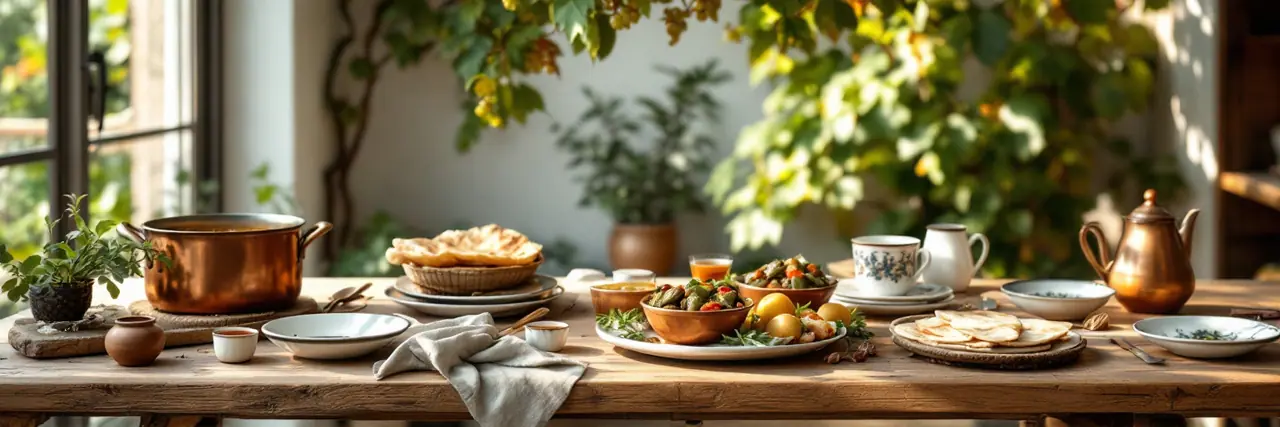
A Turkish weekend breakfast, a serpme kahvaltı, is a table covered in small plates, with tea in tulip glasses and something hot in a pan in the middle. Menemen is the obvious hot dish. Around it, you need nothing complicated: white cheese and a harder cheese, black and green olives, sliced cucumber and tomato, a few green peppers, honey with clotted cream or butter, a bowl of tahini with grape molasses, a jam, and plenty of bread. A slice of homemade bulgur bread is very good for dipping into the pan.
Here is a timing plan for six people eating at 10 am. The trick is that everything cold goes out first and the menemen is cooked last, so it arrives hot.
- 9.20: Put the water on for tea. In a Turkish double teapot, the bottom kettle boils the water and the top pot holds the leaves.
- 9.25: Take the cheeses and butter out of the fridge so they are not fridge-cold. Slice cucumbers, tomatoes and peppers onto a plate.
- 9.35: Pour boiling water over the tea leaves in the top pot, put it back on the kettle and leave it to brew on low heat for 15 minutes.
- 9.40: Set out olives, honey, jam, tahini and molasses. Warm the bread in a 180°C (350°F) oven for 5 minutes.
- 9.40: Grate 1 kg of tomatoes and slice 8 peppers for two pans of menemen.
- 9.45: Start both pans. Peppers for 5 minutes, then tomatoes for 10.
- 9.58: Add eggs, 4 to a pan, and fold.
- 10.00: Pans to the table on boards, tea poured, everyone sits down.
For six people, two pans of four eggs each is right when there is plenty else on the table. If menemen is the main thing, allow 2 eggs per person and make three pans.
Cook's questions
Can I make menemen ahead?
The sauce, yes. Cook the peppers and tomatoes up to the thick, jammy stage, cool and keep in the fridge for a day. Reheat until bubbling, then add the eggs. The eggs themselves should be cooked just before eating.
Why is my menemen watery?
The tomatoes were not cooked down long enough before the eggs went in, or the tomatoes were very watery to start with. Next time, give the sauce the spoon test and wait until the line holds.
Should menemen be spicy?
Not very. It should be warm and fresh rather than hot. Use mild peppers in the pan and let people add pul biber at the table.
The last bit in the pan, where the tomato has caught slightly and turned sticky, is the best part. In my mother's kitchen, it went to whoever had washed the tea glasses.
Filed under Seasonal Table

Ayla grew up in a Gaziantep family kitchen where bulgur came in four sizes and köfte was kneaded by feel. She lives in Bristol and writes about pilafs, kısır, köfte and the pepper pastes that hold them together.