
Kısır: Turkish bulgur salad with pepper paste and pomegranate
Kısır is what Gaziantep women bring when they visit each other. In my family no afternoon gathering happened without it: a big tray of red, glistening bulgur salad in the middle of the floor cloth, a stack of lettuce leaves, and everybody scooping and talking at the same time. It is a salad, but it is also an excuse to sit together for three hours. In Bristol I make it for picnics, for potluck suppers and, honestly, for myself on a Monday, because a bowl in the fridge feeds me for two days.
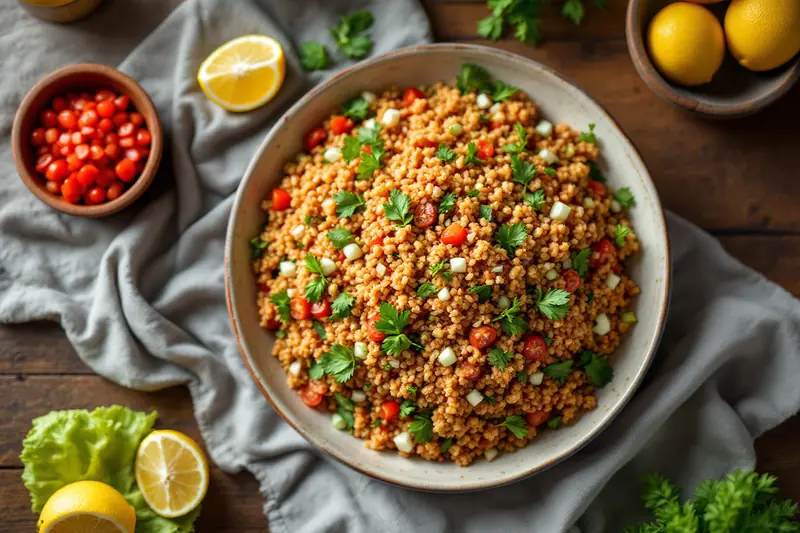
It is very simple, and it is also very easy to make badly. Dry, pale kısır with a few herbs scattered on top is a sad thing. Good kısır is moist and deep red all the way through, sharp and a little sweet, with the herbs mixed in so thoroughly that every spoonful tastes the same. The secret is not an ingredient. It is your hands.
Kısır and tabbouleh are not the same salad
People often call kısır "Turkish tabbouleh". I understand why: both are cold salads of bulgur and herbs. But they are built the other way round. In Lebanese tabbouleh the parsley is the salad, and the bulgur is a sprinkling that soaks up the lemon. In kısır the bulgur is the base. There is far more of it, it is coloured and flavoured with pepper and tomato paste, and the dressing is pomegranate molasses rather than mostly lemon. Tabbouleh is green and bright; kısır is red, earthy and filling enough to be lunch. We have a separate recipe for tabule salad, the Turkish version of the parsley salad, if you want to make both and compare.
Which bulgur
Use fine bulgur, the kind sometimes sold as köftelik bulgur. Its grains are tiny, like coarse sand, and they soften with hot water alone, without any cooking. Coarse pilaf bulgur will not work here: it stays hard in the middle unless you boil it, and boiled bulgur makes a heavy, separate kısır that never takes on the paste properly.
How much water
This is where most people go wrong, usually by adding too much. Fine bulgur needs a little less water than its own volume. I use 1 cup of just-boiled water for every 1 1/2 cups of bulgur. That looks too little when you pour it in. Trust it. Cover the bowl with a plate and leave it for 15 minutes: the bulgur will drink it all and swell. Later the tomatoes, oil, lemon and molasses add more moisture, and if you started wet you end up with porridge.
Texture check after soaking: pinch a few grains between your fingers. They should be soft with no hard centre, and the bulgur should look fluffy, not shiny with water. If there is still a little bite, cover it for another five minutes.
Knead, do not stir
Here I am going to be bossy. When the bulgur is soft and still warm, add the pepper paste, tomato paste and oil, and then put the spoon down. Use your hands and knead the bulgur for a good three or four minutes, rubbing the grains between your palms and squeezing them through your fingers. You are pressing the paste into every grain, not coating the outside. When you have finished, the bulgur should be an even brick red with no pale patches, and it should hold together loosely if you squeeze a handful. Do it while the bulgur is warm, because warm grains take up the paste much better than cold ones. If you are worried about stained hands, wear a thin glove. My aunts never did.
Only then add everything else: spring onions, tomatoes, peppers, herbs, the dressing. Mix these in with your hands too, gently now, lifting and turning.
The pepper paste matters
Turkish red pepper paste, biber salçası, comes hot or sweet. In Gaziantep we use the hot one and add pul biber on top, but a mix of hot and sweet is a good start if you are cooking for children or guests who do not like heat. If you have never cooked with it, our page on Turkish pepper paste explains how the two kinds differ and how to keep a jar once it is open. Tomato paste alone makes a flatter, sweeter kısır; it is acceptable but not the same.
Herbs, and how many
A lot. A whole bunch of flat-leaf parsley and a good handful of mint for this amount, chopped fairly fine. Chop the parsley with a sharp knife rather than in a food processor, which bruises the leaves and makes them wet. Spring onions add bite. Fresh mint is lovely, but if you only have dried, use a teaspoon and knead it in with the paste so it softens.
Recipe
Kısır (Turkish bulgur salad with pepper paste)
Serves 6 as a meze, 4 as a light lunch
- Prep
- 30 min
- Cook
- 0 min
- Rest
- 35 min
- Total
- 1 hr 5 min
Salad
- 1 1/2 cups255 g fine bulgur
- 1 cup240 ml just-boiled water
- 2 tbsp30 g Turkish red pepper paste (biber salçası), hot or sweet
- 1 tbsp15 g tomato paste
- 1/4 cup60 ml extra virgin olive oil
- 1 tsp5 g salt
- 1 tsp2 g pul biber (Turkish red pepper flakes)
- 1 tsp2 g ground cumin
- 55 spring onions, finely sliced
- 2 medium2 medium ripe tomatoes, finely diced
- 11 long green pepper, finely diced
- 1 bunch60 g flat-leaf parsley, finely chopped
- 1 handful20 g fresh mint leaves, chopped
Dressing
- 3 tbsp45 ml pomegranate molasses (nar ekşisi)
- 2 tbsp30 ml lemon juice
To serve
- 1 head1 head romaine or little gem lettuce, leaves separated
Method
- Put the bulgur in a wide bowl, pour over the just-boiled water, cover with a plate and leave for 15 minutes.
- Pinch a few grains to check they are soft right through; if not, cover for 5 minutes more.
- While the bulgur is still warm, add the pepper paste, tomato paste and olive oil.
- Knead with your hands for 3 to 4 minutes, rubbing the grains between your palms, until the bulgur is evenly brick red with no pale patches.
- Sprinkle over the salt, pul biber and cumin and knead for another minute, then leave the bulgur to cool for 10 minutes.
- Add the spring onions, tomatoes, green pepper, parsley and mint and toss gently with your hands until evenly mixed.
- Pour over the pomegranate molasses and lemon juice, mix again and taste; it should be sharp, slightly sweet and well salted.
- Leave the kısır for 20 minutes at room temperature so the flavours settle, then pile it onto a dish and serve with the lettuce leaves for scooping.
Cook's notes
- Kısır keeps for two days in the fridge; if you make it ahead, add the herbs and tomatoes on the day you serve it.
- If it tastes dull after resting, add more pomegranate molasses and salt rather than more oil.
Scaling it for a gathering
Kısır is party food, so here is the arithmetic I use. Everything scales directly except the water, which I keep at two-thirds of the bulgur's volume whatever the quantity.
| Guests (as a meze) | Fine bulgur | Just-boiled water | Pepper paste | Pomegranate molasses | Parsley |
|---|---|---|---|---|---|
| 6 | 1 1/2 cups (255 g) | 1 cup (240 ml) | 2 tbsp | 3 tbsp | 1 bunch |
| 12 | 3 cups (510 g) | 2 cups (480 ml) | 4 tbsp | 6 tbsp | 2 bunches |
| 24 | 6 cups (1 kg) | 4 cups (960 ml) | 1/2 cup | 3/4 cup | 4 bunches |
For a big batch, soak the bulgur in two bowls rather than one deep one, so it softens evenly, and knead each bowl separately. Your arms will thank you.
Variations
In late summer some families add finely chopped cucumber, or a handful of chopped walnuts for crunch. In winter, when tomatoes are poor, I leave them out and add a little more molasses and some pomegranate seeds. A spoon of sumac makes it sharper without more lemon. My mother sometimes added finely chopped purslane when it was in the market.
Serving
Serve kısır at room temperature, never straight from the fridge, when the flavours go quiet. Lettuce leaves are the traditional spoon: wrap a little in a leaf and eat it in one bite. It sits happily alongside mercimek köftesi, the red lentil and bulgur patties, on any meze table, along with olives, white cheese and a few stuffed vine leaves. Take it on a picnic in a lidded dish with the lettuce washed and packed separately, and it will be gone before the tea is poured.
Filed under Meze & Salads, Grains & Pulses

Ayla grew up in a Gaziantep family kitchen where bulgur came in four sizes and köfte was kneaded by feel. She lives in Bristol and writes about pilafs, kısır, köfte and the pepper pastes that hold them together.