
Meatless çiğ köfte: how to knead it at home
Çiğ köfte means "raw köfte", and in old south-eastern kitchens it really was raw: lean meat pounded with bulgur and peppers until the spices cooked it, in a sense. The version most people eat at home is meatless, made only with fine bulgur, peppers, onion, herbs and a lot of kneading. In Gaziantep and Urfa it is party food, made in a huge tray in early summer when the spring onions and parsley are at their best, and someone strong is always sent to the kitchen to knead.
I will be honest with you from the start. This is not a dish you can hurry. There is no cooking, no oven, no pan, but you will knead for 25 to 30 minutes, and your arms will know it. That kneading is what turns hard, gritty bulgur into a soft, dense, almost silky paste. Skip it and you have a spicy bulgur salad, which is fine, but it is not çiğ köfte.
The bulgur: the finest you can find
Use the very finest bulgur, the kind sold specifically for çiğ köfte (çiğ köftelik bulgur). It looks almost like coarse semolina. Ordinary fine köftelik bulgur also works, but needs five or ten minutes more kneading and a little more water. Never use coarse pilaf bulgur. It will never soften without cooking.
Do not soak the bulgur first in a bowl of water. You add the hot water little by little while you knead, so the grain softens under your hands. That way you control exactly how wet the mixture is.
Isot, pepper paste and the red colour
The deep, almost purple-red colour comes from isot, the dried, sun-darkened pepper flakes from Urfa. Isot is smoky, slightly sweet and only moderately hot, with a flavour a little like raisins. If you cannot find it, use the ordinary red pepper flakes called pul biber, which will make the köfte brighter red and a bit less deep. A mix of both is what I use most.
Then the pastes. Hot red pepper paste (acı biber salçası) gives heat and body; tomato paste softens it and adds sweetness. You can read more about the different kinds in the notes on Turkish pepper paste. If your family does not like heat, use mild pepper paste and keep the isot, which gives flavour more than fire.
Wear thin kitchen gloves. I mean it. Isot and pepper paste on bare hands for half an hour will burn, and the colour stays under your nails for two days.
How to knead, step by step
This is how I do it, in stages, so each ingredient gets worked into the grain properly.
Stage one: bulgur and spices, 10 minutes
Put the bulgur in a wide, shallow bowl or tray, add the isot, pul biber, cumin, black pepper and salt, and rub them together with your fingertips. Add the pepper paste and tomato paste. Now start kneading, pressing the mixture down with the heel of your hand and folding it back over. Every two or three minutes, sprinkle over 3 or 4 tablespoons of hot water. After ten minutes the grain should be evenly red and starting to clump.
Stage two: onion and garlic, 10 minutes
Grate the onions directly into the bowl so you keep all the juice, and add the crushed garlic. The onion juice softens the bulgur further. Keep kneading and adding small amounts of water. The mixture will go from crumbly to sticky. It should feel like a stiff, heavy dough.
Stage three: oil, molasses and herbs, 5 to 10 minutes
Add the olive oil, lemon juice and pomegranate molasses and knead them in. The mixture turns glossy and smells much rounder. Finally work in the finely chopped spring onions, parsley and mint, just until they are evenly spread.
The texture check
This is the most useful thing I can teach you about çiğ köfte. Pinch off a piece the size of a walnut and press it flat between your thumb and finger. If the edges crack and crumble, keep kneading and add a little water. If it holds together in a smooth disc with only fine lines at the edge, it is ready. Taste it too: the grains should feel soft in your mouth, not sharp or sandy. If you bite down and feel grit, give it another five minutes.
On a hot June day the whole process takes me about 28 minutes. In a cooler kitchen, closer to 35.
Recipe
Etsiz çiğ köfte (meatless çiğ köfte)
About 40 pieces, serves 8 as a meze
- Prep
- 45 min
- Cook
- 0 min
- Rest
- 15 min
- Total
- 1 hr
Köfte
- 2 cups340 g extra-fine bulgur (çiğ köftelik bulgur)
- 3 tbsp15 g isot (Urfa pepper flakes)
- 1 tbsp6 g pul biber (Turkish red pepper flakes)
- 2 tsp4 g ground cumin
- 1 tsp2 g black pepper
- 2 tsp10 g salt
- 3 tbsp45 g hot red pepper paste (acı biber salçası)
- 1 tbsp15 g tomato paste
- 1 1/4 cups300 ml hot water, added a little at a time
- 2 medium2 medium onions, grated
- 3 cloves3 cloves garlic, crushed
- 1/3 cup80 ml olive oil
- 2 tbsp30 ml lemon juice
- 2 tbsp30 ml pomegranate molasses
- 66 spring onions, very finely chopped
- 1 bunch1 bunch flat-leaf parsley, very finely chopped
- 1 small bunch1 small bunch fresh mint, leaves very finely chopped
To serve
- 2 heads2 heads cos (romaine) lettuce, leaves separated
- 22 lemons, cut into wedges
- 3 tbsp45 ml pomegranate molasses, for drizzling
Method
- Put on thin gloves. Mix the bulgur, isot, pul biber, cumin, black pepper and salt in a wide tray, then add the pepper paste and tomato paste.
- Knead for 10 minutes, pressing with the heel of your hand and folding, sprinkling over 3 to 4 tbsp of hot water every 2 to 3 minutes, until the mixture is evenly red and starts to clump.
- Grate the onions straight into the tray, add the garlic, and knead for 10 minutes more, adding water a little at a time, until the mixture feels like a stiff, heavy dough.
- Add the olive oil, lemon juice and pomegranate molasses and knead for 5 minutes until glossy.
- Check the texture: press a walnut-sized piece flat; if the edges crumble or the grains feel gritty, knead for 5 minutes more with a splash of water.
- Work in the spring onions, parsley and mint until evenly spread, then taste and adjust the salt, lemon and heat.
- Cover the tray and leave for 15 minutes so the flavours settle.
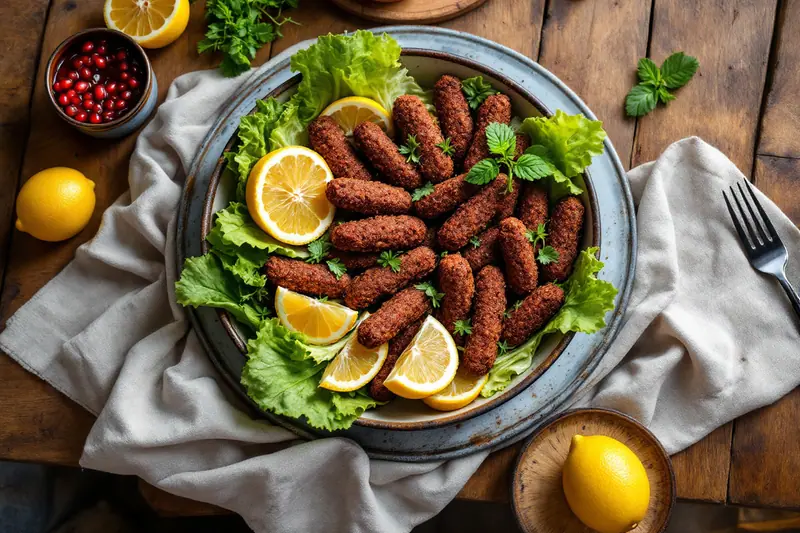
- Take a piece the size of a large walnut, squeeze it once in your fist to make the classic finger-ridged shape, and lay it on a platter; repeat with the rest.
- Serve with the lettuce leaves, lemon wedges and pomegranate molasses so everyone can wrap their own.
Cook's notes
- Çiğ köfte is best on the day it is made; covered and chilled it keeps for 1 day, and is better left to come back to room temperature before serving.
- For a milder version use mild pepper paste and halve the pul biber, keeping the isot for flavour.
Shaping and serving
The classic shape comes from squeezing a piece in your closed fist, so it comes out long with ridges from your fingers. It looks rough and homemade, which is the point. Some families roll small balls instead, or press the whole mixture flat on a tray and cut it into diamonds. All fine.
To eat it, take a lettuce leaf, put a piece of köfte in it with a squeeze of lemon and a few drops of pomegranate molasses, maybe a mint leaf and a slice of radish, and fold. Cos lettuce has the crispest leaves for this. Some people also use thin flatbread (lavaş) to make wraps.
Scaling for a crowd
Çiğ köfte is often made for a lot of people at once, and the arithmetic is simple, but the kneading is not. For 16 people, double everything: 4 cups (680 g) bulgur, 2 1/2 cups (600 ml) hot water, and so on. Do not try to knead the double batch alone in one tray. Split it into two trays and knead them side by side, or bring in a second pair of hands. Your knuckles will thank you.
Cook's questions
Can I use a food processor instead of kneading?
Partly. A processor will break the bulgur down and mix the pastes in about 5 minutes, and that saves your arms. But it heats the mixture and makes it pasty rather than dense, and it cannot judge the water for you. I let the machine do stage one, then finish stages two and three by hand. The texture check still applies.
My mixture is too wet. What now?
You added the water too fast. Leave the tray uncovered for 15 minutes so the bulgur drinks up the extra, then knead again. If it is still sloppy, work in 2 or 3 tablespoons of dry fine bulgur and give it another 5 minutes.
Why is it bitter?
Usually old or burnt isot, or too much cumin. Taste your isot before you start: it should taste sweet and smoky, never acrid. A little extra pomegranate molasses and lemon will balance a slightly bitter batch.
Can I make it the day before?
You can, but the herbs wilt and darken overnight. Make the base up to stage three the day before, chill it covered, and knead in the fresh herbs an hour before serving.
What to serve with it
On a summer table it sits with other cold dishes: a plate of mercimek köftesi, the softer lentil version made with cooked red lentils, a bowl of kısır, cacık, and ayran to drink. Strong black tea comes afterwards, always.
Filed under Meze & Salads

Ayla grew up in a Gaziantep family kitchen where bulgur came in four sizes and köfte was kneaded by feel. She lives in Bristol and writes about pilafs, kısır, köfte and the pepper pastes that hold them together.