Poğaça: soft Turkish cheese buns with parsley
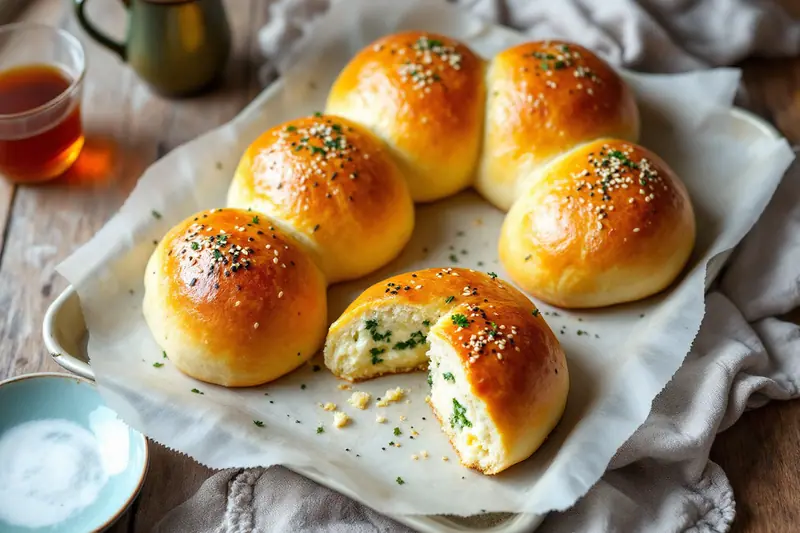
Every bakery in Istanbul has a glass case of poğaça by seven in the morning. They are small, soft, savoury buns, glossy on top and so tender that they give under your thumb, with a seam of salty white cheese and parsley inside. You buy two or three in a paper bag with a glass of tea, and you eat them on the way somewhere. In Toronto I could not find them like that, so I learned to make them, and after a lot of trays I have settled on a dough and a method that I trust.
Poğaça (pronounced roughly "poh-AH-cha") is a family of buns rather than one recipe. Some are flaky and short, made with butter or margarine and no yeast, and crumble when you bite them. The bakery kind I am writing about here is different: a yeasted dough enriched with yogurt and oil, which bakes up soft and fluffy and stays that way for a day. Everything below is about getting that softness, and about the small details of temperature and timing that decide whether the buns rise high or spread flat.
Why yogurt and oil
The dough has four liquids, and each has a job. Warm milk wakes the yeast and gives a fine, white crumb. Yogurt adds a gentle tang and makes the dough tender, because its acidity relaxes the gluten. Sunflower oil coats the gluten strands and keeps the crumb soft once the buns cool. An egg white adds a little structure so the buns hold a rounded shape; the yolk is saved for the glaze.
I have made the same dough with melted butter instead of oil. It tastes richer when warm, but butter sets firm as it cools, and by the afternoon those buns were noticeably tighter. Oil stays liquid at room temperature, so the crumb stays soft. That is the bakery secret, if there is one. Use a neutral oil: sunflower, or a light olive oil. A strong peppery olive oil fights with the cheese.
Use full-fat plain yogurt. A thick strained yogurt is fine but may need an extra tablespoon of milk, because the dough should come out soft, not firm.
Temperatures that matter
I am precise about a few numbers here because they change the result.
The milk should be warm, about 38°C (100°F). It should feel barely warm on the inside of your wrist. Much hotter and you weaken the yeast; cold milk from the fridge will slow the first rise by half an hour or more. Take the yogurt and the egg out of the fridge 30 minutes before you start, for the same reason.
The first rise works best at about 25°C (77°F). A kitchen at normal room temperature in winter may be closer to 20°C (68°F), which is why I often put the covered bowl in the oven with only the light switched on. Check after 20 minutes that it is not getting too warm; the dough should never feel hot.
The oven is 180°C (350°F) for a conventional oven, or 160°C (320°F) with the fan. Poğaça need gentle heat. At 200°C (400°F) the tops brown before the insides have set, and the buns come out dark, small and slightly doughy in the middle. A baked bun reads about 90°C (195°F) in the centre with a probe thermometer, if you have one. If not, tap the base: it should sound hollow and look evenly pale gold.
The dough, by feel
The quantity of flour is a range, because flours absorb differently. Start with 560 g and keep the last 30 g back. Mix everything into a soft dough and knead for 5 to 7 minutes. Only add the extra flour if the dough is still sticking to your hands after 3 minutes of kneading.
Here is the texture check I use. When it is right, the dough is smooth, slightly shiny from the oil, and as soft as an earlobe. Press it with a fingertip: it should feel like it might stick, then release cleanly. Pull off a walnut-sized piece and stretch it between your fingers. It should stretch a few centimetres before tearing, not snap straight away. If it snaps, knead for 2 more minutes. If it is so soft that it spreads on the worktop when you leave it for a minute, work in another tablespoon of flour.
The most common mistake with poğaça is too much flour. A stiff dough is easy to shape, which is tempting, but it bakes into a dry, bready bun. Oil your hands instead of flouring them when you shape.
The filling
The filling is very simple: white cheese and parsley. White cheese (beyaz peynir) is a brined cheese, similar to feta. Different cheeses vary a lot in salt, so taste a crumb. If it makes you wince, soak the block in cold water for 30 minutes, then pat it dry.
The important part is dryness. Wet cheese and wet parsley leak through the seams in the oven and leave the bun hollow with a puddle underneath. Crumble the cheese finely with a fork, wash and dry the parsley thoroughly in a towel before you chop it, and mix the two together. A pinch of pul biber is a nice addition. Some families bind the filling with a spoonful of the egg white; I find it is not needed.
You need about 11 g of filling per bun, which is a heaped teaspoon. More than that and the seams will not close.
Shaping, step by step
Once the dough has doubled, which takes 45 to 60 minutes at 25°C (77°F), tip it out onto an oiled surface and press out the air gently.
- Divide the dough into 18 pieces of about 60 g. Weighing them is worth it: equal buns bake in the same time.
- Roll each piece into a ball under a cupped hand. Cover the balls with a cloth while you work so they do not form a skin.
- Start with the first ball you rolled, since it has rested longest. Flatten it with your fingers into a disc about 8 cm across, slightly thinner at the edges than the middle.
- Put a heaped teaspoon of filling just off centre.
- For the classic half-moon, fold the disc over the filling and press the edges firmly together, then press again with the side of your finger to seal. For a round bun, gather the edges up over the filling like a purse, pinch them shut and set the bun seam side down.
- Place the buns on a tray lined with baking paper, about 4 cm apart. Eighteen fit on one standard oven tray, just; use two trays if yours is small.
At this point, any buns you want to freeze go into the freezer. More on that below.
Cover the rest loosely and leave them for 25 to 30 minutes, until they look puffy and a gentle press with a fingertip leaves a dent that springs back slowly. Heat the oven during this time.
The glaze and the seeds
Beat the reserved yolk with a tablespoon of milk and a teaspoon of oil. The milk thins it so it spreads evenly; the oil gives the shine you see in bakery windows. Brush it on gently with a soft brush, all the way down the sides, without letting it pool on the tray, where it burns.
Then the seeds. Nigella seeds (çörek otu) are the classic choice, small and black with a faintly oniony, peppery taste. You will find them, and more about how they are used, in our guide to the Turkish pantry. Sesame seeds are the other option, and many bakeries scatter both on the same tray. Sprinkle them straight after glazing, while the egg is wet, so they stick.
Poğaça with white cheese and parsley
Recipe
Poğaça (soft Turkish cheese buns)
Makes 18 buns
- Prep
- 40 min
- Cook
- 22 min
- Rest
- 1 hr 30 min
- Total
- 2 hr 32 min
Dough
- 1 cup240 ml whole milk, warmed to about 38°C (100°F)
- 2 tsp7 g instant dried yeast
- 1 tbsp12 g sugar
- 1/2 cup125 g plain full-fat yogurt, at room temperature
- 1/2 cup120 ml sunflower oil
- 11 egg white (keep the yolk for the glaze)
- 1 1/2 tsp9 g fine salt
- 4 1/2 to 4 3/4 cups560 to 590 g plain flour (all-purpose flour)
Filling
- 1 1/2 cups200 g white cheese (beyaz peynir) or feta, finely crumbled
- 1/2 cup20 g flat-leaf parsley, washed, dried and finely chopped
- 1 pinch1 pinch pul biber (optional)
Glaze
- 11 egg yolk
- 1 tbsp15 ml milk
- 1 tsp5 ml sunflower oil
- 1 tbsp8 g nigella seeds or sesame seeds, or a mix
Method
- Stir the warm milk, yeast and sugar together in a large bowl and leave for 5 minutes until a little foamy.
- Whisk in the yogurt, oil and egg white, then add the salt and 560 g of the flour and mix into a soft dough.
- Knead for 5 to 7 minutes until smooth and as soft as an earlobe, adding the last 30 g of flour only if it still sticks to your hands after 3 minutes.
- Cover and leave at about 25°C (77°F) for 45 to 60 minutes, until doubled.
- Mix the cheese, parsley and pul biber in a small bowl.
- Divide the dough into 18 pieces of about 60 g, roll into balls and keep them covered.
- Flatten each ball into an 8 cm disc, add a heaped teaspoon of filling, fold into a half-moon and press the edges twice to seal.
- Set the buns 4 cm apart on a lined tray, cover loosely and leave for 25 to 30 minutes until puffy; heat the oven to 180°C (350°F), or 160°C (320°F) with the fan.
- Beat the yolk with the milk and oil, brush it gently over the buns and scatter with the seeds.
- Bake on the middle shelf for 20 to 22 minutes until evenly golden and the bases sound hollow when tapped.
- Cool on the tray for 5 minutes, then move to a rack and cover with a clean cloth to keep them soft.
Cook's notes
- Freeze shaped, unglazed buns on the tray for 2 hours, then bag them; thaw and rise them for about 2 hours before glazing and baking.
- If your cheese is very salty, soak it in cold water for 30 minutes and pat it dry before crumbling.
A worked timing plan
Poğaça look like an all-morning job, but most of the time is waiting. This is the plan I follow for a late Sunday breakfast:
| Time | Step |
|---|---|
| 7.30 | Take the yogurt and egg out of the fridge. |
| 8.00 | Warm the milk, mix and knead the dough. Cover and set it to rise. |
| 8.15 | Make the filling. Line the tray. Wash up. |
| 9.00 | Dough has doubled. Divide, weigh and shape (about 20 minutes for 18 buns). |
| 9.20 | Second rise. Switch on the oven. |
| 9.35 | Mix the glaze. |
| 9.48 | Glaze, seed and bake. |
| 10.10 | Out of the oven, under a cloth. |
They are best eaten 10 to 20 minutes out of the oven, when the cheese is still warm but the crumb has had time to set. So the buns are really ready at about 10.25. I put the tea on as the tray comes out, and it has brewed by the time they are ready to break open.
Freezing unbaked buns
This is the reason I make poğaça in double batches. Shaped, unbaked buns freeze very well, and a tray of fresh ones on a weekday morning takes almost no effort.
Shape and fill the buns as usual but do not give them the second rise, and do not glaze them. Put the tray straight into the freezer for about 2 hours, until the buns are hard. Then transfer them to a freezer bag, press out the air and label it. They keep well for up to one month. After that the yeast weakens and the buns rise less.
To bake from frozen, set the buns on a lined tray 4 cm apart, cover loosely with oiled cling film and leave them at room temperature for about 2 hours, until they have thawed and look puffy. The fingertip test is the same as before: a slow spring back. Then glaze, seed and bake as normal; they may need 1 or 2 minutes longer.
If mornings are tight, put the frozen buns on the tray the evening before, cover them and leave them in the fridge overnight. In the morning take them out, leave them at room temperature for 45 minutes to 1 hour while the oven heats, then glaze and bake.
I glaze only after thawing for a reason. Egg glaze frozen on the dough cracks as the buns expand, and the finished tops come out patchy and dull.
Baked poğaça freeze too. Cool them completely, bag them and reheat from frozen at 160°C (320°F) for 8 to 10 minutes, wrapped loosely in foil. They are softer when frozen unbaked, but this is still far better than any bun bought the day before.
Cook's questions
Why did my poğaça spread flat?
Usually one of three things: the dough had too little flour and could not hold its shape, the buns over-proved in the second rise, or the oven was not fully heated. Check the fingertip test carefully; if a dent does not spring back at all, they have gone too far.
Can I make them without yeast?
Yes, but that is a different bun, the crumbly kind made with butter and baking powder. This yogurt and oil dough needs yeast to be soft.
What else can go inside?
Grated kaşar cheese with a little dill, mashed potato with pul biber, or black olive paste. Keep the filling dry and the same quantity per bun.
How long do they stay soft?
Covered with a cloth or in a closed tin, until the next morning. After that, warm them for 5 minutes at 160°C (320°F).
What to serve with them
Poğaça belong on a breakfast table with tea, olives, tomatoes, cucumber and a few slices of cheese. They are also a good thing to make ahead for an iftar table, since a tray of frozen buns can go in the oven while the soup heats. More breads and pastries to bake are in our breads and pastries collection.
In Istanbul bakeries the buns at the edges of the tray are always a little darker than the ones in the middle. I turn my tray halfway through baking to even them out. Even so, one bun near the back corner of my oven always comes out a shade darker than the rest, and that is the one I take for myself.
Filed under Breads & Pastries

Defne grew up in Istanbul and bakes in Toronto. She writes about milk puddings, syrupy sweets, pastry and festive tables, and she is exact about sugar, temperatures and timing.