
Ezogelin soup: red lentil and bulgur soup with dried mint
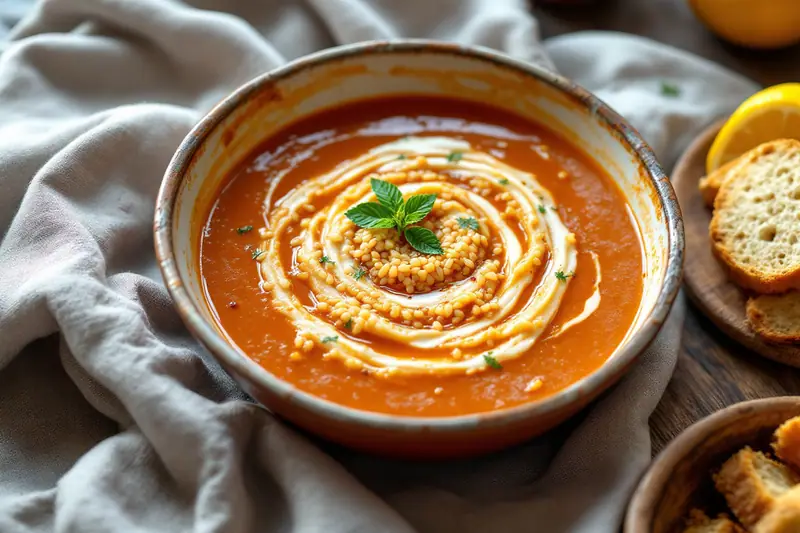
Ezogelin çorbası is the soup I make when the fridge is nearly empty and the day has been long. Everything in it comes from the cupboard: red lentils, a spoonful of bulgur, a spoonful of rice, an onion, two kinds of paste and a good pinch of dried mint. In about 45 minutes you have a pot that is thick, warming, a little spicy and much more interesting than the sum of those plain parts.
In Turkish homes and in soup shops across the country, ezogelin sits right next to plain red lentil soup on the menu, and people who do not know them well think they are the same thing. They are not. Plain red lentil soup is smooth, pale orange and gentle, usually blended until velvety and finished with lemon. Ezogelin is redder, earthier and more rustic. The bulgur and rice stay as soft grains you can see and feel, the pepper paste gives it a warm sweetness and a little heat, and the dried mint is not a garnish but a main flavour.
The name means "Ezo the bride". The soup is linked to a well-known folk story about a young woman from the Gaziantep region, told in many versions, and I will leave the telling to people from there. What I can tell you is how to make it so it tastes right.
What makes ezogelin work
Three things decide whether your ezogelin tastes like the real thing or like lentil soup with some rice in it.
The pastes, fried properly
Ezogelin uses both tomato paste and Turkish red pepper paste (biber salçası). The tomato paste gives depth and colour; the pepper paste gives a rounded, slightly smoky sweetness and, if you use the hot kind, some heat. Both must be fried in the butter with the onion for a minute or two before any water goes in. You will see the paste darken from bright red to brick red and smell it turn sweet. Skip this and the soup tastes raw and sharp. If you are new to pepper paste, our guide to Turkish pepper paste explains the hot and sweet kinds and what to use if you cannot find either.
Enough dried mint, in two stages
Dried mint goes in twice: a tablespoon rubbed between your palms into the pot near the end of cooking, and another sizzle of it in hot butter poured over each bowl. Dried mint is not the same as fresh. It has a deeper, almost tea-like flavour that only comes out with heat, and fresh mint will not give you that. Rub it between your hands as it goes in; that wakes it up.
Grains that stay grains
The bulgur and rice are there for texture. The lentils will break down into a thick purée on their own, while the rice softens and the bulgur stays slightly chewy. This is why many cooks do not blend ezogelin at all, or only give it a few short pulses. If you blend it smooth, you lose the point of adding grains in the first place.
Which bulgur and which rice
For bulgur, I use coarse pilaf bulgur because it holds its shape best through 35 minutes of simmering. Fine bulgur also works and is what many families use; it melts further into the soup and makes it a little thicker. Do not soak either kind first. They go straight into the pot with the lentils. If you are unsure which grind you have, the guide on how to cook bulgur shows the difference.
For rice, any short or medium-grain white rice is right. The extra starch from these rices helps thicken the soup. Long-grain rice works but stays more separate. Rinse the rice with the lentils in the same sieve.
For the lentils, use split red lentils, the small orange ones. Rinse them in a sieve until the water runs mostly clear, which takes three or four changes of water. This removes the dust and some of the surface starch that otherwise makes a lot of grey foam.
How thick should ezogelin be?
Thicker than plain lentil soup, but still a soup, not a porridge. Here is the check I use. Dip a ladle in, lift it out and turn it over. The soup should coat the back of the ladle in an even orange layer and run off slowly in a thick ribbon, not in drips. If it sits on the ladle in lumps, it is too thick. If it runs off in a thin stream and leaves the ladle almost clean, it is too thin.
Ezogelin keeps thickening as it stands, because the lentils and rice keep absorbing liquid. A pot that is just right when you turn off the heat will be too thick 20 minutes later, and set almost solid in the fridge overnight. So always keep a kettle of hot water nearby, and thin it a ladleful at a time just before serving. Taste for salt after you thin it, since extra water dilutes the seasoning.
The recipe
Recipe
Ezogelin çorbası (red lentil, bulgur and rice soup with dried mint)
Serves 6 as a starter, 4 as a main with bread
- Prep
- 10 min
- Cook
- 45 min
- Total
- 55 min
Soup
- 1 cup190 g split red lentils
- 2 tbsp25 g short or medium-grain white rice
- 2 tbsp20 g coarse or fine bulgur
- 2 tbsp30 g butter
- 1 tbsp15 ml olive oil or sunflower oil
- 1 medium1 medium onion, finely chopped
- 2 cloves2 cloves garlic, finely chopped, optional
- 1 tbsp15 g tomato paste
- 1 tbsp15 g Turkish red pepper paste (biber salçası), hot or sweet
- 7 cups1.7 litres hot water or light vegetable or chicken stock, plus extra for thinning
- 1 tbsp2 g dried mint
- 1 tsp2 g pul biber (Turkish red pepper flakes)
- 1 1/2 tsp8 g salt, less if using salted stock
- 1/2 tsp1 g freshly ground black pepper
Mint butter to finish
- 2 tbsp30 g butter
- 1 tsp1 g dried mint
- 1 tsp2 g pul biber
- 11 lemon, cut into wedges, to serve
Method
- Put the lentils and rice in a sieve and rinse under cold running water, rubbing with your fingers, until the water runs mostly clear. Drain well.
- Melt the butter with the oil in a large heavy pot over medium heat. Add the onion and cook for 6 to 8 minutes until soft and lightly golden; add the garlic for the last minute.
- Stir in the tomato paste and pepper paste and fry for 1 to 2 minutes, stirring, until they darken to brick red and smell sweet.
- Add the lentils, rice and bulgur and stir for a minute so they are coated in the paste.
- Pour in the hot water or stock, raise the heat and bring to the boil. Skim off any grey foam that rises in the first few minutes.
- Lower the heat, partly cover the pot and simmer for 30 to 35 minutes, stirring every 10 minutes and scraping the bottom, until the lentils have collapsed and the rice is completely soft.
- Rub the dried mint between your palms into the pot, add the pul biber, salt and black pepper, and simmer for 5 minutes more.
- For a slightly smoother soup, whisk hard for a minute or give it three or four short pulses with a stick blender; the grains should still be visible.
- Check the thickness with the ladle test and thin with hot water a ladleful at a time if needed, then taste for salt again.
- For the mint butter, melt the butter in a small pan until foaming, take it off the heat, add the mint and pul biber and swirl for 20 to 30 seconds.
- Ladle the soup into bowls, spoon a little of the sizzling butter over each and serve with lemon wedges and bread.
Cook's notes
- The soup thickens as it stands; keep a kettle of hot water nearby to loosen it before serving.
- Do not let the mint butter brown or the mint will taste bitter.
A weeknight timing plan
On a working evening I come in, put the kettle on and take my coat off in that order. While the kettle boils, I rinse the lentils and rice and chop the onion, which takes about ten minutes. The onion goes into the butter, the pastes follow, then the lentils, grains and hot water from the kettle, so the pot is simmering within twenty minutes of walking through the door. The next half hour is free, apart from a stir every ten minutes: time to lay the table, warm the bread in a low oven at 150°C (300°F) and cut the lemons. The mint and seasoning go in at the 50 minute mark, and the mint butter is the very last thing, made while someone else carries the bowls to the table.
Scaling it up: a pot for twenty
Ezogelin is one of the cheapest ways I know to feed a big table well. For a family gathering, a school event or a winter evening with neighbours, I multiply the recipe by three and a bit. Allow about one large ladle, around 300 ml, per person as a starter.
For 20 people:
- Red lentils: 3 1/2 cups, about 665 g
- Rice and bulgur: 7 tbsp of each, about 90 g rice and 70 g bulgur
- Onions: 3 medium
- Butter: 100 g, with 3 tbsp oil
- Tomato paste and pepper paste: 3 tbsp of each
- Water or stock: 6 litres to start, with another litre hot and ready for thinning
- Dried mint: 3 tbsp in the pot, plus a small bowl of mint butter for the table
- Salt: start with 1 1/2 tbsp, then taste
You need a pot of at least 10 litres, because lentils foam as they come to the boil. Allow longer for everything: 10 to 12 minutes for the onions, 20 minutes for the water to come back to the boil, and about 40 minutes of simmering. Stir more often, every five minutes towards the end, because a big pot of lentils catches on the bottom easily. If it does catch, do not scrape it. Pour the soup into a clean pot and leave the scorched layer behind.
Variations
Some cooks add a small grated carrot with the onion for sweetness. Others use only tomato paste and a teaspoon of paprika when there is no pepper paste in the house, which works, though it tastes flatter. In some homes the soup is finished with a squeeze of lemon in the pot rather than at the table. A spoonful of sumac sprinkled over each bowl gives a pleasant sourness if you have no lemons.
For a richer version, cook it in chicken stock and stir a knob of butter into the pot at the end. For a vegan version, use olive oil instead of butter all the way through, and finish with mint and pul biber sizzled in olive oil.
Storing, freezing and reheating
Ezogelin keeps for four days in a covered container in the fridge. It will set thick, almost like a purée. To reheat, put it in a pot with a splash of hot water, warm it over low heat, stirring, and add more water a little at a time until it reaches ladle-coating thickness again. Taste for salt.
It freezes well for up to three months. I freeze it in portions in flat bags, without the mint butter, and label each one. Thaw overnight in the fridge, then reheat and make fresh mint butter while it warms. A frozen portion and a quick butter sizzle make a proper lunch in ten minutes.
Cook's questions
Can I make ezogelin without bulgur?
Yes. Use 4 tablespoons of rice instead of 2 rice and 2 bulgur. You lose a little chew and nuttiness, but it is still recognisably ezogelin. Some families also make it with only bulgur and no rice.
Why is my soup foaming so much?
Red lentils release starch and protein that rise as foam when they boil. Rinsing well removes much of it, and skimming in the first few minutes takes care of the rest. A tablespoon of oil or butter in the pot also helps keep it down.
Hot or sweet pepper paste?
Either. Hot pepper paste gives a gentle warmth that most adults like. With children at the table, use sweet paste in the pot and put pul biber on the table for anyone who wants more heat.
What do I serve with it?
Warm bread, lemon wedges and a few pickles are enough. For a fuller meal, follow it with a plate of bulgur pilaf and a simple salad of tomato, cucumber and onion.
Filed under Soups

Nuray comes from Kayseri and now lives in Frankfurt. She writes about soups, beans, lentils and slow winter stews, with an eye on what a pantry can stretch to across a busy week.