
Bulgur vs couscous vs quinoa: what differs and when to swap
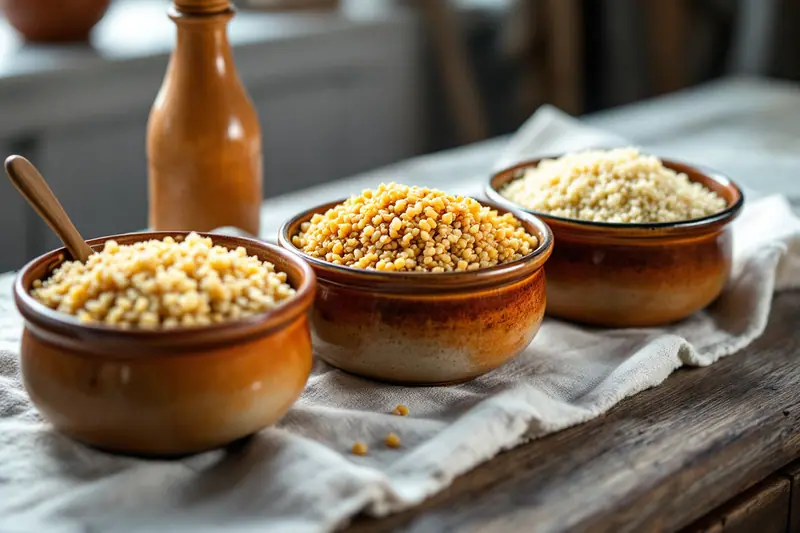
Put a spoonful of cooked bulgur, a spoonful of couscous and a spoonful of quinoa on a plate and most people at my table in Rotterdam could not tell you which is which from across the room. All three are small, pale and grainy, all three cook fast, and all three end up in salads with parsley and lemon. Up close they are very different foods. One is a cracked whole grain, one is a tiny pasta, and one is not a cereal at all but the seed of a leafy plant.
Those differences decide what happens when you swap one for another in a Turkish recipe. Some swaps work beautifully. Some give you a soggy salad or köfte that falls apart in the pan. I cooked all three side by side on the same evening, with the same cup and the same kettle, to see exactly where the lines are.
How each one is made
Bulgur
Bulgur starts as whole wheat kernels, usually durum wheat. The kernels are boiled until cooked through, dried (traditionally spread out in the sun on rooftops and courtyards in late summer), and then cracked into pieces of different sizes. Some of the bran is rubbed off along the way. Because the wheat was cooked before cracking, bulgur at home only needs rehydrating, which is why fine bulgur softens in a bowl of hot water.
The grind matters more with bulgur than with the other two. Fine bulgur is for köfte and kısır, coarse bulgur is for pilaf, and whole-kernel bulgur is chunky and chewy. The full breakdown, with ratios for every grind, is in the guide on how to cook bulgur.
Couscous
Couscous is made from semolina, the coarse flour milled from durum wheat. The semolina is sprinkled with water and rolled by hand or machine so the particles clump into tiny pellets. These are then steamed and dried. In other words, couscous is a small pasta, not a grain. The quick couscous sold in most shops has been steamed and dried already, so it needs nothing more than boiling water and five minutes under a lid.
There is a twist for Turkish cooks. What Turkish shops sell as kuskus is a larger, rounder pasta, more like the pearl couscous you may know, made from semolina or flour and water and often toasted. It is cooked like a pilaf in butter and stock, and it behaves quite differently from the fine North African kind. When a Turkish recipe says kuskus, it means the big pearls.
Quinoa
Quinoa is the seed of a plant from the Andes that is related to spinach and beetroot rather than to wheat. It is cooked and eaten like a grain, which is why you will see it called a pseudo-cereal. Each seed has a natural bitter coating called saponin. Most packed quinoa has been washed, but I still rinse it in a sieve under the cold tap for a minute, because the bitterness is easy to taste if any remains. Cooked quinoa shows a little white curl around each seed, which is the germ coming loose. That curl is how you know it is done.
The comparison table
These are the figures from my side-by-side evening: one cup of each, about the same weight of dry product, cooked the standard way and measured once fluffed.
| Bulgur (coarse) | Couscous (fine, quick) | Quinoa | |
|---|---|---|---|
| What it is | Boiled, dried, cracked wheat | Small pasta from durum semolina | Seed of an Andean plant |
| Contains gluten | Yes | Yes | No |
| Dry weight per cup | About 170 g | About 180 g | About 170 g |
| Liquid per cup | 1 3/4 to 2 cups | 1 to 1 1/4 cups | 1 3/4 to 2 cups |
| Method | Fry, simmer, rest | Pour boiling liquid over, cover | Rinse, simmer, rest |
| Time | 12 to 15 min plus 10 min rest | 5 min, no heat | 15 min plus 5 min rest |
| Cooked volume per cup dry | About 2 3/4 cups | About 2 1/2 cups | About 3 cups |
| Texture | Chewy, separate, nutty | Soft, fluffy, slightly clumping | Light pop, a little crunch |
| Taste | Toasty wheat | Mild, like plain pasta | Grassy, slightly earthy |
| Holds dressing | Very well, even overnight | Soaks it up fast, softens | Well, stays springy |
| Binds when kneaded | Fine grind binds well | Partly | No |
The cooked volumes are close enough to swap cup for cup in most recipes. The liquid is where you must be careful. Couscous needs roughly half the water of the other two, and if you pour two cups of liquid over one cup of quick couscous you will have a wet paste.
Texture, which is the real difference
Taste aside, the three behave differently in the mouth and in the bowl, and that decides the swaps.
Bulgur has the most chew. Coarse bulgur grains stay distinct even after a night in the fridge in dressing, which is why kısır made the day before is often better than kısır made an hour ago. Fine bulgur, when it is kneaded, turns sticky enough to hold a shape. That stickiness is the whole basis of çiğ köfte and lentil köfte.
Couscous is the softest. It absorbs liquid quickly and keeps absorbing it, so a couscous salad dressed in the morning is noticeably softer by the evening. It does not have the grip of bulgur, and the pellets tend to clump unless you fork them apart while they are still warm with a little oil or butter.
Quinoa has a gentle pop. The seeds stay springy in dressing and do not go soggy, but they never stick together. You cannot knead quinoa into anything without help from an egg, flour or mashed potato.
Swaps in Turkish dishes
Here is what happened when I tried each swap at home, dish by dish.
Kısır
Classic kısır is made with fine bulgur soaked in a little hot water, then rubbed with pepper paste, tomato paste, onion, herbs, lemon and pomegranate molasses.
With fine couscous, it works if you are quick. Soak it with slightly less water than the bulgur (about 3/4 cup per cup of couscous), rub the pastes in while it is warm, and serve it the same day. It tastes softer and sweeter, and it loses the nutty edge.
With quinoa, it works very well, and it is the swap I recommend to friends who avoid wheat. The texture is lighter and the herbs stand out more. Our quinoa salad is built on exactly this idea, with cucumber, tomato and pomegranate.
Bulgur pilaf
Quinoa can replace coarse bulgur in a pilaf with almost no change in method: fry the onion, add the rinsed and drained quinoa, stir for a minute, add hot stock at about 1 3/4 cups per cup, simmer covered for 15 minutes and rest. The result is lighter and less hearty.
Couscous is a poor swap here. It does not need simmering, and if you simmer it the way you simmer bulgur you get a soft mass. If you want a couscous side with the same flavours, fry the onion and paste in butter, add the boiling stock, take the pan off the heat, stir in the couscous and cover for five minutes.
Köfte
This is where only bulgur will do. Çiğ köfte and mercimek köftesi rely on fine bulgur soaking up liquid and then being kneaded until it holds together. Couscous gets partway there but crumbles when shaped, and quinoa will not bind at all. If you need a wheat-free köfte, look for a different recipe rather than swapping the grain.
Stuffed peppers
Quinoa is excellent in olive-oil stuffed peppers. It cooks inside the pepper without turning to mush and soaks up the olive oil and tomato. We have a whole recipe for quinoa and walnut stuffed peppers. Coarse bulgur also works, and is the more traditional choice in many south-eastern homes. Couscous goes soft and heavy inside a pepper; I would not use it.
Soup
Bulgur gives body to soups like ezogelin and to yogurt soups. Quinoa can stand in, cooked in the soup for 15 minutes, but it stays distinct and does not thicken the broth the way bulgur does. Couscous added to soup dissolves into a starchy cloud within minutes; if you like that, add it right at the end.
A worked example: one dinner, three grains
When friends come round and I am not sure who eats what, I make one salad base three ways. For eight people, as a side alongside grilled meat or beans:
- 1 cup fine bulgur, soaked with 3/4 cup just-boiled water, rested 15 minutes
- 1 cup quick couscous, covered with 1 cup boiling water and a teaspoon of oil, rested 5 minutes, forked apart
- 1 cup quinoa, rinsed and simmered in 1 3/4 cups water for 15 minutes, rested 5 minutes, spread on a tray to cool
That gives roughly 2 1/2 to 3 cups of each, about 8 cups in total, enough for eight generous side portions. I make one big batch of dressing (pepper paste, lemon, olive oil, pomegranate molasses, salt) and divide it in three. The bulgur gets its share first, while still warm, because it takes the paste best that way. The quinoa gets dressed once cool so the herbs stay bright. The couscous goes last, just before serving, because it softens quickest. Then the same chopped spring onions, parsley, mint and tomato go into all three bowls.
Every time, the bulgur bowl empties first. But the quinoa bowl is the one people ask about.
Storing all three
Dry, all three keep for months in sealed jars in a cool cupboard. Bulgur and couscous are wheat and can go stale; quinoa keeps its flavour well but can pick up smells from spices stored next to it.
Cooked, all three keep for three to four days in the fridge. Bulgur holds its texture best. Quinoa is close behind. Couscous gets softer every day, so cook it closest to when you need it. Cooked bulgur and quinoa both freeze well in flat bags for up to three months; couscous freezes too, but comes back softer.
Which one to keep in the cupboard
If you cook Turkish food often, bulgur is the one you cannot do without, because köfte, kısır and pilaf all depend on it. Keep both fine and coarse if you have the room. Quinoa is the most useful second, as a wheat-free stand-in for salads, pilaf and stuffed vegetables. Quick couscous is the emergency option, ready in five minutes when there is nothing else in the house and people are already at the table.
My own cupboard holds a jar of each. The bulgur jar is the one I refill every fortnight.
Filed under Kitchen Notes, Grains & Pulses

Murat's family is from the Black Sea coast; he lives in Rotterdam. He likes to test things side by side: soaking times, oven temperatures, bread doughs, chickpeas cooked five ways, and the weeknight plans that come out of it.