
Kabak tatlısı: Turkish candied pumpkin with tahini and walnuts
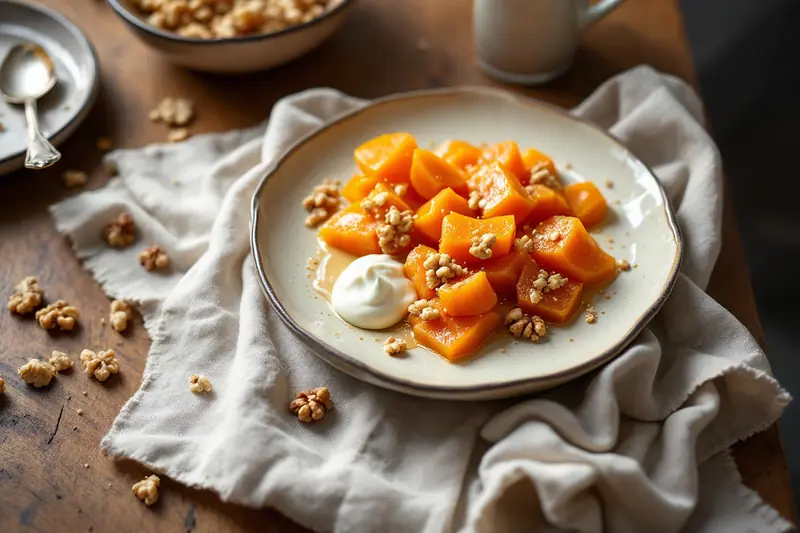
When the first cold mornings arrive in Istanbul, the greengrocers start selling pumpkin by the slab, already peeled, the orange flesh stacked in neat wedges beside the scales. If you ask for a kilo, the seller will usually ask you back: for tatlı? He means kabak tatlısı, the candied pumpkin that turns up on almost every autumn table in the city. It is one of the plainest sweets in the Turkish kitchen: pumpkin, sugar and time. There is no syrup made separately and almost no water. The sugar draws the juice out of the pumpkin overnight, and that juice becomes the syrup the pieces poach in the next day.
Because the method is so simple, the small decisions carry the whole dish. Which squash you buy, how much sugar goes on each kilo, how thick you cut the pieces and how low you keep the heat will decide whether you get translucent, jewel-like pieces that hold their shape or a pan of sweet orange mush. I have made both. Here is what I do now in my kitchen in Toronto, where the autumn markets are full of every squash except the one my mother used.
Choosing the pumpkin
In Turkey the pumpkin for this sweet is bal kabağı, "honey pumpkin", a dense, deep-orange winter squash with a fine grain and very little stringiness. Outside Turkey you want the same qualities: firm, dry, sweet flesh with a strong colour. Good choices are butternut squash, kabocha, Crown Prince and the smaller pie or sugar pumpkins. Avoid the large carving pumpkins sold for lanterns. They are watery and pale, they release too much juice, and the pieces collapse before they turn glossy.
A quick test at the shop: press a thumbnail into the cut face. Good pumpkin for tatlı resists and feels almost like a raw sweet potato. If it gives easily and beads with water, buy something else.
You will lose roughly a fifth of the weight to peel and seeds, so for 1 kg of prepared pumpkin start with about 1.25 kg whole. Keep the seeds if you like; rinsed, dried and roasted with salt they make a good snack while the pumpkin rests.
How much sugar: a ratio for every taste
Turkish home recipes vary wildly on sugar, from a cup per kilo to nearly equal weights. I weigh the peeled pumpkin and work from that. These are the ratios I have tested, all for 1 kg of prepared pumpkin:
| Sugar per 1 kg pumpkin | Result |
|---|---|
| 200 g | Lightly sweet, soft, not much syrup. Eat within two days. |
| 250 g | My standard. Glossy, holds its shape, a spoonful of syrup per serving. |
| 300 g | Candied edges, thick syrup, firmer pieces. Keeps longest. |
To scale, multiply. If your squash gives 1.4 kg of prepared flesh and you want the standard version, you need 1.4 × 250 g = 350 g sugar. If you only have 700 g of flesh, use 175 g. The ratio matters more than the absolute amount, because the sugar both sweetens and controls how much juice comes out, and juice is your syrup.
Plain white granulated sugar gives the cleanest colour. Light brown sugar works but turns the pieces darker and slightly muddy; I keep it for the oven variation below.
Why the overnight rest matters
You can cook kabak tatlısı the same day by adding a little water to the pan, and I explain how below. But the overnight rest is what gives the classic texture. The sugar pulls water out of the cells by osmosis, so the pieces firm up a little before they ever see heat, and by morning they sit in a pool of bright orange juice. Then, when you cook them in that juice, they candy rather than boil.
Arrange the pieces in a single layer in a wide, heavy pan, cut sides up, and pour the sugar evenly over the top so every piece wears a white cap. Cover and leave somewhere cool (a cold kitchen or the fridge) for 8 to 12 hours. In the morning the sugar will have mostly dissolved and the pieces will be half submerged. If a few still have dry sugar on top, that is fine; it melts in the first minutes of cooking.
Cutting the pieces
Cut the pumpkin into pieces roughly 6 cm long, 4 cm wide and 2 cm thick. Thinner pieces cook through before they have time to turn glossy; much thicker ones stay pale in the middle. Try to keep them all the same thickness, which matters more than the shape. Some cooks cut neat rectangles, others keep the curved wedge shape of the slice. Both look lovely on the plate.
Use a sharp, heavy knife and cut the squash into rings or wedges first, then peel each one flat on the board. It is far safer than trying to peel a whole round pumpkin.
Cooking low and covered
This is the stage where patience pays. Put the pan over low heat with the lid on, and do not stir. The juice will come to a gentle simmer after about 10 minutes. From then on you want small, lazy bubbles around the edges, never a rolling boil, which breaks the pieces.
After about 25 minutes, turn each piece over gently with a fork or a pair of spoons. The underside should already look slightly translucent. Put the lid back and cook for another 15 to 20 minutes, until a skewer slides in with no resistance and the pieces look like dark orange glass at the edges.
Then take the lid off. Let the syrup bubble gently for 10 to 15 minutes more, spooning it over the pumpkin now and then. It is ready when the syrup has reduced to a thin, shiny layer in the bottom of the pan and coats the back of a spoon. If you have a thermometer, it will read about 105°C (221°F). Do not take it further, or the syrup will set too firm when cold.
Let everything cool completely in the pan, then chill. Kabak tatlısı is always served cold, and it firms up as it chills.
Recipe
Kabak tatlısı (Turkish candied pumpkin)
Serves 6
- Prep
- 20 min
- Cook
- 55 min
- Rest
- 8 hr
- Total
- 9 hr 15 min
Pumpkin
- 2.2 lb1 kg peeled, seeded pumpkin or firm winter squash (about 1.25 kg whole), cut into pieces 6 cm x 4 cm x 2 cm
- 1 1/4 cups250 g granulated sugar
- 44 whole cloves (optional)
To serve
- 6 tbsp90 g tahini, well stirred
- 3/4 cup75 g walnuts, roughly crushed
- 6 tbsp120 g kaymak or clotted cream
Method
- Arrange the pumpkin pieces in a single layer in a wide, heavy pan, cut sides up, and tuck in the cloves if using.
- Sprinkle the sugar evenly over the pieces so each one is covered, then put on the lid.
- Leave in a cool place or the fridge for 8 to 12 hours, until most of the sugar has dissolved and the pieces sit half covered in orange juice.
- Set the covered pan over low heat without stirring and bring it slowly to a gentle simmer, which takes about 10 minutes.
- Simmer gently, lid on, for 25 minutes, then turn each piece over carefully with a fork.
- Cover again and cook for 15 to 20 minutes more, until a skewer slides in easily and the edges look translucent.
- Uncover and simmer for 10 to 15 minutes, spooning syrup over the pieces, until the syrup is shiny and coats a spoon.
- Cool completely in the pan, then chill for at least 2 hours.
- Serve each portion with a spoon of syrup, a drizzle of tahini, crushed walnuts and a spoon of kaymak.
Cook's notes
- No time for the overnight rest? Add 120 ml water with the sugar and start cooking straight away; the pieces will be a little softer.
- Remove the cloves before serving if you do not want anyone to bite into one.
Tahini, walnuts and kaymak
The toppings are not decoration. Cold candied pumpkin on its own is very sweet; the tahini brings a bitter, toasty edge, the walnuts bring crunch, and the kaymak (Turkish clotted cream) cools everything down. In Istanbul you will often see it served with only tahini and walnuts, and that is how I eat it on an ordinary weeknight.
Stir the tahini well before using, because the oil separates in the jar. If it is too thick to drizzle, loosen it with a teaspoon of the pumpkin syrup rather than water, which makes it seize. Crush the walnuts by hand or with a rolling pin; ground walnuts disappear into the syrup.
Kaymak is hard to find outside Turkey. Clotted cream is the closest match. Thick strained yogurt is a fine, sharper alternative if you want something less rich.
Variations
Oven-baked
Lay the sugared pieces in a baking dish after their overnight rest, cover tightly with foil and bake at 180°C (350°F) for 40 minutes. Uncover, baste with the juice and bake for another 20 to 25 minutes until glossy. The oven gives more even heat and fewer broken pieces, which helps if your hob runs hot. Light brown sugar suits this version.
With a crisp shell
In some homes the pumpkin is soaked for a few hours in water mixed with food-grade slaked lime (kireç) before it meets the sugar. The lime firms the outside so the pieces stay crisp at the surface and soft inside. It is a traditional trick, but you need the food-grade product and careful rinsing afterwards, and I rarely bother for a family dessert.
Spiced
A cinnamon stick or a few strips of orange peel in the pan are good. Keep it to one flavour so the pumpkin still tastes of pumpkin.
Storing and making ahead
Kabak tatlısı is a make-ahead sweet by nature. Kept in its syrup in a covered container in the fridge, it lasts four to five days at the standard sugar ratio, and closer to a week with 300 g per kilo. Add the toppings only when you serve; tahini and walnuts go soft in the fridge.
For a dinner, I cook it two days before and lift the pieces onto a platter an hour ahead so they lose the fridge chill slightly. If you are planning a full autumn table, it sits well after a pot of red lentil soup and a bulgur pilaf. For a sweet spread, set it beside a bowl of aşure or the baked sütlaç rice pudding; between them they cover fruit, grain and milk.
Cook's questions
Why did my pumpkin fall apart?
Usually the heat was too high or the squash was watery. Keep the simmer so gentle that the surface barely moves, and choose a dense squash. Stirring also breaks the pieces; turn them once, individually.
My syrup set hard in the fridge. Can I save it?
Yes. Warm the pan gently with two or three tablespoons of water until the syrup loosens, then cool again. Next time take it off the heat a few minutes earlier.
Can I use less sugar?
You can go down to about 200 g per kilo. Below that there is not enough syrup to candy the pieces and they simply stew, and they will not keep for more than a day or two.
Can I freeze it?
Not well. The texture turns watery after thawing. Make it fresh; it only takes ten minutes of actual work.
Filed under Desserts, Seasonal Table

Defne grew up in Istanbul and bakes in Toronto. She writes about milk puddings, syrupy sweets, pastry and festive tables, and she is exact about sugar, temperatures and timing.