
Tas kebabı: Turkish slow-cooked beef stew with pepper paste
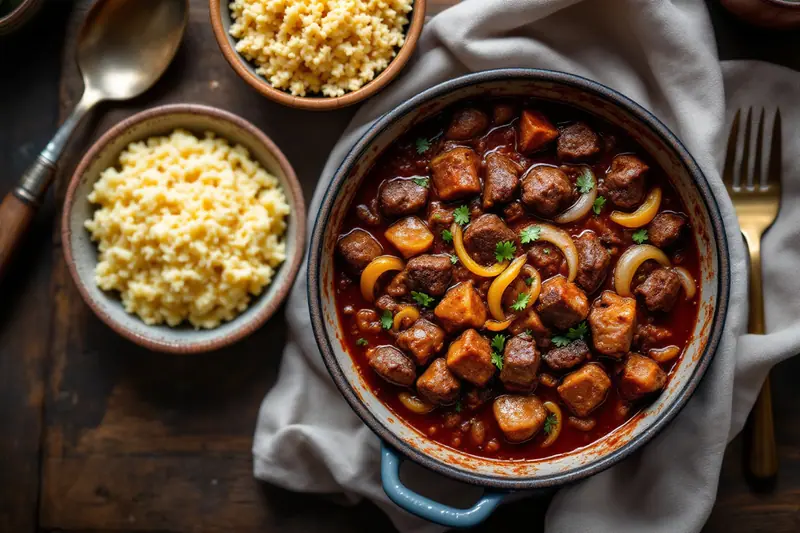
Tas kebabı is a kebab that never goes near a grill. The name means "bowl kebab", and it is a stew: pieces of beef or lamb browned well, then cooked slowly in a heavy pot with onion, tomato and pepper paste until the meat is tender and the sauce is thick, dark red and glossy. It is a winter dish in Kayseri, where I grew up, and it is a winter dish in my kitchen in Frankfurt too. One pot feeds four people with very little meat each, because the sauce does so much of the work.
It is also one of the most forgiving stews I know. There are only a few things that decide whether it turns out rich or watery, tender or chewy, and none of them is difficult. You need the right cut, patience with the browning, a pot that holds heat, and enough time. Everything else is detail.
Which meat to buy
Buy a cut that would be tough if you grilled it. That sounds wrong, but it is the whole point of slow cooking. Lean, tender cuts like sirloin or fillet dry out and turn stringy after two hours in a pot. Cuts with connective tissue and a little fat running through them start out tough and finish soft, because that tissue melts into the sauce and gives it body.
For beef, ask for chuck (often sold as braising steak or stewing steak in the UK), blade, or shin. Chuck is my usual choice: it has an even marbling and holds its shape. Shin is cheaper and becomes very silky, but it needs half an hour longer. For lamb, use boneless shoulder or neck fillet. Lamb leg is too lean.
Here is where a budget helps rather than hurts. Ready-cut "stewing beef" in a tray is often trimmings from several cuts, so some pieces are tender after an hour and others are still tough after two. I buy a single piece of chuck, about 1 kg, and cut it myself at home. It takes ten minutes and usually costs less per kilo than the pre-cut tray. Cut it into pieces about 3 cm across, a little bigger than you think, because they shrink. Trim any thick hard fat and the silvery skin, but leave the thin lines of fat inside the meat.
Why you brown in batches
Browning is where most of the flavour in tas kebabı comes from, and it is the step people rush. If you tip a whole kilo of cold meat into a pot at once, the pan temperature falls, the meat releases its juices, and it boils in them. You get grey meat sitting in pale liquid. That liquid will never turn into a rich sauce.
So dry the meat with kitchen paper first, then brown it in three batches. Heat a little oil in the pot over medium-high heat until it shimmers. Lay the pieces in with space between them and leave them alone for three to four minutes. Do not stir. When a piece lifts away easily and the underside is deep brown, turn it and brown another side. Each batch takes about eight minutes. Move the browned meat to a bowl and do the next batch.
At the end you will have a dark brown crust on the bottom of the pot. Do not wash it off. It goes into the sauce with the onions and is the base of the whole dish.
A small knob of butter with the last batch gives a rounder flavour. My mother always finished the browning that way, and I do the same.
A heavy pot
Use the heaviest pot you have with a lid that fits well: an enamelled cast-iron casserole is ideal, a thick stainless-steel pot is fine. A thin pot develops hot spots, the sauce catches on the bottom during the long simmer, and you have to stand over it stirring. A heavy pot holds a steady, low heat, so you can leave it for half an hour at a time and get on with something else.
The size matters too. For 1 kg of meat, a pot of about 24 cm across and 4 to 5 litres is right. Too large and the liquid spreads thin and evaporates; too small and the browning becomes a long job.
Onion, pepper and the two pastes
After the meat comes out, lower the heat and add two onions, finely chopped, with a pinch of salt. The salt draws out moisture, and that moisture loosens the brown crust from the bottom of the pot. Scrape as you stir. Cook the onions for about eight minutes until soft and golden, then add two long green peppers, chopped, for another three minutes.
Now the pastes. Tas kebabı uses both tomato paste and Turkish red pepper paste, one tablespoon of each. The pepper paste gives a deep, slightly sweet, slightly smoky warmth that tomato alone cannot, and it is what makes the sauce taste Turkish. Use mild or hot, as you prefer; I use mild and add a little pul biber at the end. If you want to know more about the two styles and how to keep a jar, read about Turkish pepper paste.
Fry the pastes in the oil for two full minutes, stirring. They darken a shade and smell sweet. This takes away the raw, tinny taste. Then add two grated tomatoes and cook for a few minutes more.
Liquid and timing
Return the meat with any juices from the bowl, season with salt and black pepper and a teaspoon of dried thyme, and pour in hot water until the meat is just covered, about three cups for a kilo. Water is enough. The browned crust and the pastes make the stock for you. Bring it to a boil, skim off any grey foam, then turn the heat right down, put the lid on and let it bubble only gently, one or two lazy bubbles at a time.
Timings depend on the cut:
| Meat (1 kg, 3 cm pieces) | Simmer time | Tender when |
|---|---|---|
| Beef chuck or blade | 1 hour 30 to 1 hour 45 | a piece breaks apart when pressed with a spoon |
| Beef shin | 2 hours to 2 hours 15 | the gelatinous parts are soft and clear |
| Lamb shoulder or neck | 1 hour 15 to 1 hour 30 | a fork slides in with no resistance |
Check the pot every 30 minutes and add a splash of hot water if the liquid has dropped below the meat. In the last 20 minutes, take the lid off so the sauce reduces. When it is ready, the sauce should coat the back of a spoon and leave a clear trail when you draw a finger through it. You should see a thin layer of red oil on the surface.
If you prefer the oven, after the boil and skim put the covered pot in at 160°C (325°F) for the same times. The oven gives an even heat with no risk of sticking, which is useful if you are cooking a double batch.
The recipe
Recipe
Tas kebabı (Turkish beef stew with pepper paste)
Serves 4 generously, 6 with plenty of rice or mash
- Prep
- 20 min
- Cook
- 2 hr 5 min
- Rest
- 10 min
- Total
- 2 hr 35 min
Stew
- 2 1/4 lb1 kg boneless beef chuck (or lamb shoulder), cut into 3 cm pieces
- 3 tbsp45 ml sunflower or olive oil
- 1 tbsp15 g butter
- 2 medium2 medium onions, finely chopped
- 22 long green peppers, chopped
- 1 tbsp15 g tomato paste
- 1 tbsp15 g Turkish red pepper paste (biber salçası), mild or hot
- 2 medium2 medium ripe tomatoes, grated, skins discarded
- 3 cups720 ml hot water
- 1 1/2 tsp8 g salt, plus a pinch for the onions
- 1/2 tsp1 g black pepper
- 1 tsp1 g dried thyme
To finish
- 1/2 tsp1 g pul biber (Turkish red pepper flakes), optional
- 2 tbsp8 g flat-leaf parsley, chopped
Method
- Pat the meat dry with kitchen paper and divide it into three batches.
- Heat 1 tbsp oil in a heavy pot over medium-high heat until it shimmers, add the first batch with space between the pieces and leave for 3 to 4 minutes until deep brown underneath.
- Turn the pieces and brown on a second side, about 8 minutes per batch in all, then move to a bowl; repeat with the rest, adding the butter with the last batch.
- Lower the heat to medium, add the onions with a pinch of salt and cook for 8 minutes, scraping up the brown crust, until soft and golden.
- Add the green peppers and cook for 3 minutes, then stir in the tomato paste and pepper paste and fry for 2 minutes until a shade darker.
- Add the grated tomatoes and cook for 3 minutes, then return the meat and its juices with the salt, black pepper and thyme.
- Pour in the hot water to just cover the meat, bring to the boil and skim off any grey foam.
- Cover, turn the heat to low and simmer very gently for 1 hour 30 to 1 hour 45 for chuck (1 hour 15 for lamb), checking every 30 minutes and adding a splash of hot water if the meat is uncovered.
- Uncover for the last 20 minutes, until the sauce coats a spoon and a thin layer of red oil shows on top.
- Taste for salt, rest off the heat for 10 minutes, and scatter with pul biber and parsley to serve.
Cook's notes
- Tas kebabı keeps for 3 days in the fridge and freezes well for up to 3 months; reheat gently with a splash of water.
- For a one-pot meal, add two peeled potatoes cut into large chunks for the last 35 minutes.
Making it ahead
Like most stews, tas kebabı is better the next day. The sauce thickens, the flavours settle, and any fat rises and sets on top so you can lift some off if you like. I cook it on a Sunday afternoon and we eat it on Monday evening, when I am tired and have no wish to cook.
Cool it with the lid off for about an hour, then cover and refrigerate. To reheat, warm it over low heat with two or three tablespoons of water, stirring now and then, for about 15 minutes until the sauce bubbles and the meat is hot right through. Do not boil it hard, or the meat tightens.
Here is a plan for a weekday dinner for eight, doubling the recipe in one large pot:
- Sunday, 3 pm: cut 2 kg of chuck and brown it in six batches, about 50 minutes.
- Sunday, 3.50 pm: onions, peppers, pastes, tomatoes; return the meat, add 5 cups (1.2 litres) of water. Not six: the larger quantity loses less to evaporation.
- Sunday, 4.10 pm: lid on, into the oven at 160°C (325°F).
- Sunday, 6 pm: check tenderness, reduce on the hob for 20 minutes if needed.
- Sunday, 7.30 pm: into the fridge once cool.
- Wednesday, 6.30 pm: reheat slowly while the rice cooks.
What to serve it with
In Turkish homes tas kebabı is served with one of two things, and both are there to catch the sauce.
The first is a plain, buttery rice pilaf, with separate, glossy grains. Spoon the stew alongside, not on top, so the rice stays fluffy at the edges and soaks up sauce where they meet.
The second is mashed potato, and this is how I usually serve it on cold evenings. Make it soft and smooth with warm milk and butter, a little looser than you might for other dishes, and spread it on a plate with a well in the middle for the meat. A spoonful of thick plain yogurt beside it is lovely too.
A plate of pickles or a simple salad of shredded white cabbage with lemon cuts through the richness. For more ideas for the main part of the meal, look through our mains.
Cook's questions
My meat is still tough after two hours. What went wrong?
Either the cut was too lean, or the pot boiled too hard and the meat seized. Lower the heat and keep going; check every 15 minutes. Chuck that is tough at 1 hour 30 is often perfect at 2 hours.
Can I use a pressure cooker?
Yes. Brown the meat and cook the sauce as written, then use 2 cups (480 ml) of water and cook at pressure for 35 to 40 minutes. Reduce the sauce with the lid off afterwards.
Can I add other vegetables?
Carrots, peas or potatoes are common additions. Add carrots with the water, potatoes for the last 35 minutes and peas for the last 5.
The sauce is too thin. How do I fix it?
Simmer it uncovered for 10 to 15 minutes, stirring now and then. Avoid flour; a well-reduced sauce thickens on its own.
When the pot is empty, there is always a dark red layer stuck to the bottom. Pour in a ladle of hot water, scrape it up, and keep it in a jar for tomorrow's lentil soup.
Filed under Mains

Nuray comes from Kayseri and now lives in Frankfurt. She writes about soups, beans, lentils and slow winter stews, with an eye on what a pantry can stretch to across a busy week.