Quinoa stuffed peppers with walnuts, currants and herbs
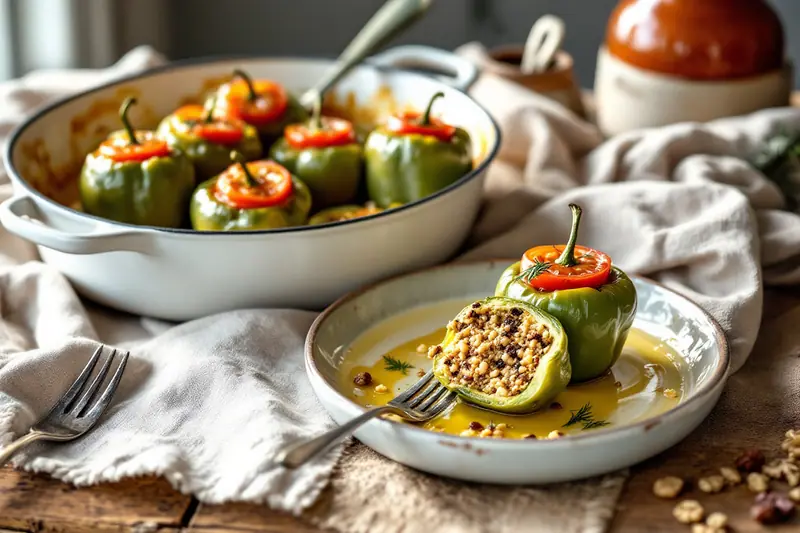
There are two families of dolma in Turkey. One is filled with meat and rice and eaten hot, with yogurt. The other is zeytinyağlı, cooked in olive oil with no meat at all, and eaten cool or at room temperature, the kind of dish that sits on the table at lunch and gets better while everyone talks. These peppers belong to the second family. The usual filling is rice with onions, pine nuts, currants and herbs. Here I swap the rice for quinoa and add walnuts, and the result is lighter, a little nutty, and holds its shape well when the peppers are cut.
I first made them on a spring Saturday after coming back from the market in Lisbon with a bag of thin-skinned green peppers and nothing much else planned. Quinoa was in the cupboard, walnuts too. It worked so well that I now make this version as often as the rice one.
Choosing the peppers
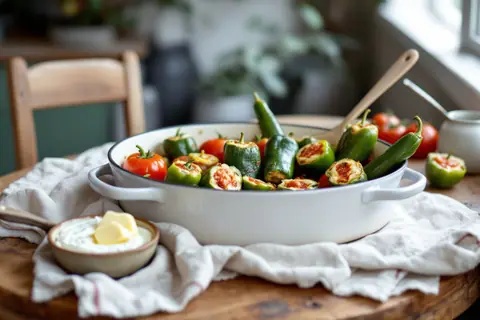
The best peppers for dolma are the small, pale green, thin-skinned ones sold in Turkey as dolmalık biber. They are squat, about the size of a fist, with a mild, sweet flavour. Outside Turkey, look for small green bell peppers, or the pale green "Hungarian" style peppers that turn up at Turkish and Middle Eastern greengrocers. Large thick-walled bell peppers work but take longer to soften, and you will need fewer of them.
Pick peppers that stand up on their own. Cut a circle around the stem with a small knife, pull it out like a lid, and scrape out the seeds and white ribs with a teaspoon. Keep the lids if you like the look, or cap each pepper with a thick slice of tomato, which is what I do.
Why quinoa works here
Quinoa behaves a lot like rice in a dolma, with two differences that matter. It cooks faster, and it does not go sticky. Rice in a zeytinyağlı filling needs a long, slow simmer and can turn to paste if you overdo it. Quinoa stays as separate little grains, so the filling is loose and fresh, and each mouthful has some texture.
Rinse it first in a fine sieve under cold running water for a minute, rubbing it with your fingers. Quinoa has a natural bitter coating, and most of it washes off. Skip this and the whole pan tastes faintly soapy.
Then I half-cook the quinoa in the pan with the onions before stuffing. That is the key decision. Raw quinoa stuffed into the peppers can swell and split them, and it needs more liquid than the pan gives. Half-cooked quinoa finishes gently inside the pepper and soaks up the olive oil and lemon from the pan. If you enjoy quinoa this way, the quinoa salad uses it cold with a similar herb mix.
Building the filling
The base is onions, lots of them, cooked slowly in olive oil until soft and sweet. This is not the place to save time. Twelve to fifteen minutes on a medium-low heat, until they are translucent and just starting to turn gold at the edges. The flavour of the whole dish rests on them.
Then come the things that make a zeytinyağlı filling taste the way it should: a spoonful of tomato paste, a pinch of sugar, allspice, a little cinnamon, black pepper. Currants (the small dried grapes, not blackcurrants) give little sweet bursts. Walnuts, roughly chopped, add body and a gentle bitterness that balances the sugar. Fresh dill is essential, with parsley and mint alongside. Add the herbs only after the quinoa has come off the heat, so they stay green.
How full to stuff them
Fill each pepper about three quarters full and press lightly. The quinoa will swell a little more as it cooks, and an overstuffed pepper either splits or pushes its tomato cap off. As a rough guide, 1 cup of dry quinoa makes enough filling for 10 small dolma peppers or 6 medium bell peppers.
Stand the peppers upright in a pan that holds them snugly, so they lean on each other and cannot fall over. A 24 cm pan takes 10 small ones.
Recipe
Zeytinyağlı kinoalı cevizli biber dolması (quinoa and walnut stuffed peppers)
10 small stuffed peppers, serves 5 as a main or 10 as a meze
- Prep
- 35 min
- Cook
- 50 min
- Rest
- 30 min
- Total
- 1 hr 55 min
Filling
- 1/3 cup80 ml olive oil
- 2 large2 large onions, finely chopped
- 1 cup170 g quinoa, rinsed well
- 1 tbsp15 g tomato paste
- 1 cup240 ml hot water
- 3 tbsp30 g currants, soaked in warm water for 10 minutes
- 1/2 cup60 g walnuts, roughly chopped
- 1 tsp4 g sugar
- 1 tsp2 g ground allspice
- 1/2 tsp1 g ground cinnamon
- 1 1/2 tsp8 g salt
- 1/2 tsp1 g black pepper
- 1 small bunch1 small bunch dill, finely chopped
- 1/2 bunch1/2 bunch flat-leaf parsley, finely chopped
- 1 tbsp1 tbsp fresh mint, finely chopped (or 1 tsp dried)
Peppers and pan
- 10 small10 small thin-skinned green peppers (or 6 medium bell peppers)
- 1 large1 large tomato, sliced into rounds for caps
- 1 1/2 cups360 ml hot water
- 3 tbsp45 ml olive oil
- 2 tbsp30 ml lemon juice
- 1/2 tsp2 g sugar
Method
- Warm the olive oil in a wide pan over a medium-low heat and cook the onions for 12 to 15 minutes, stirring now and then, until soft, sweet and just turning gold at the edges.
- Add the rinsed quinoa and stir for 2 minutes, then stir in the tomato paste for 1 minute until it darkens.
- Pour in the 240 ml hot water, add the drained currants, walnuts, sugar, allspice, cinnamon, salt and pepper, cover and simmer for 7 to 8 minutes until the water is absorbed and the quinoa is half cooked.
- Take off the heat, stir in the dill, parsley and mint, and leave to cool for 10 minutes.
- Cut the stems out of the peppers, scrape out the seeds and ribs, and fill each one three quarters full, pressing lightly.
- Cap each pepper with a tomato slice and stand them upright and snug in a 24 cm pan.
- Mix the 360 ml hot water, olive oil, lemon juice and sugar and pour it around the peppers, not over them.
- Lay a small heatproof plate on top to keep the peppers steady, cover with the lid and bring to a simmer.
- Cook on a low heat for 35 to 40 minutes, until the peppers are soft and slightly wrinkled and a knife slides through a wall easily.
- Turn off the heat and let the peppers cool in the pan, covered, for at least 30 minutes before lifting them out and spooning over the pan juices.
Cook's notes
- Like all zeytinyağlı dishes these are best at room temperature, and they taste even better the next day.
- Large bell peppers need 45 to 50 minutes in the pan.
A timing plan for a weekend lunch
Because these peppers need to cool, they are a good dish to make in the morning and forget about. This is how I do it when friends come at one o'clock:
- 10:00: chop the onions and herbs, rinse the quinoa, soak the currants.
- 10:15: cook the onions slowly, then the quinoa.
- 10:40: stuff the peppers while the filling is still just warm, which makes it easier to press in.
- 10:50: into the pan, on a low heat.
- 11:30: heat off, lid on, and leave the pan alone on the stove.
- 13:00: lift them onto a platter, spoon over the juices, add a few dill fronds.
For twenty people, double the recipe and use two pans rather than one large deep one. Peppers stacked in two layers cook unevenly, and the bottom ones collapse.
Hot, warm or cold
Zeytinyağlı dishes are traditionally served at room temperature. The olive oil sets slightly in the fridge and tastes dull when cold, so if you have chilled them, take them out an hour before you eat. Just warm is also very good, especially on a cool spring evening. What I would avoid is serving them straight from the stove: the flavours have not had time to settle, and the filling tastes flat.
Variations
For a more traditional pan, replace the quinoa with 1 cup of medium-grain rice, washed and soaked for 20 minutes, and cook the peppers for 45 minutes. Pine nuts instead of walnuts are the classic choice, about 3 tablespoons, toasted in the oil before the onions. In summer I sometimes add a handful of finely chopped tomato to the filling. The same filling works in small courgettes (zucchini), hollowed out with a teaspoon, or in vine leaves, though for those I would follow a proper yaprak sarma method with rice.
What to serve with them
As a main course, two peppers each with a bowl of thick yogurt, some bread and a green salad is a good lunch. As part of a meze table they sit happily next to white bean piyaz, a plate of cheese and some olives. For a whole tray of mixed dolma, aubergines and courgettes included, the guide to stuffed vegetables has the method for a larger pan.
Storing
Keep leftover peppers in their juices in a covered dish in the fridge for up to three days. Spoon a little of the pan liquid over them before serving, and give them time to lose the chill.
Filed under Mains

Bora is from İzmir and cooks the Aegean way: olive oil, vegetables, herbs and a table full of mezes. He lives in Lisbon, shops at the market most mornings and writes about dolma, salads and dishes served at room temperature.