Etli dolma: stuffed peppers, courgettes and tomatoes
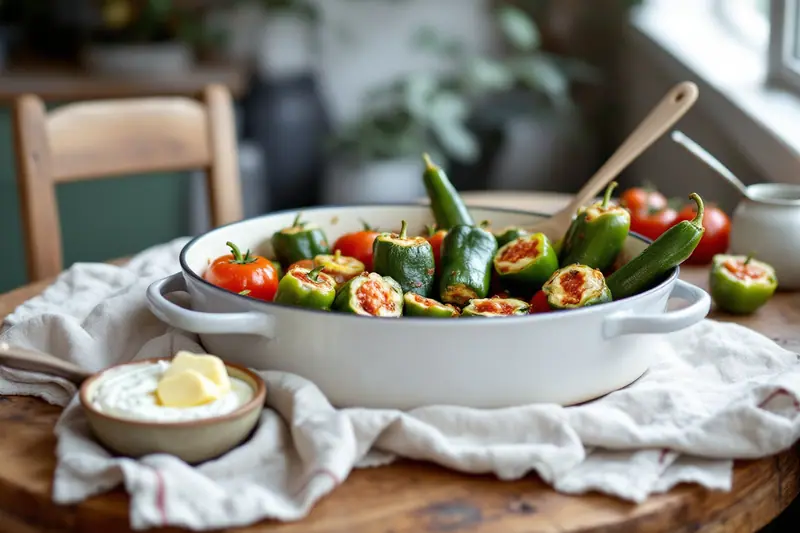
At the Saturday market near my flat in Lisbon there is a stall that sells small green peppers, firm round courgettes and tomatoes that still smell of the plant. When I see all three together in late summer I buy enough for a pot of etli dolma, the meat-stuffed vegetables my mother made in İzmir on the days the whole family came to lunch. It is a generous, unhurried dish. You make one filling of rice, mince, onion and herbs, push it into three different vegetables, pack them upright in a pot and let them simmer slowly in a tomato broth until everything is soft and the rice has swollen.
The trick that makes this version work is planning the pot around the vegetables. Peppers, courgettes and tomatoes cook at different speeds and hold different amounts of filling. Once you know that, the rest is easy, and you get a pot where every piece is done at the same moment.
One filling, three vegetables
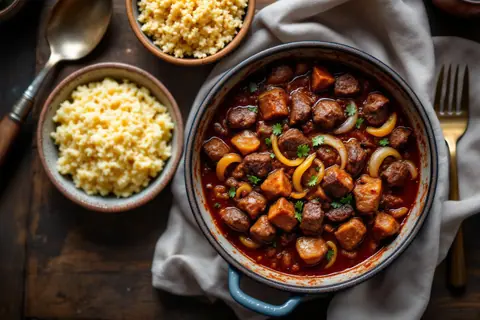
The word dolma simply means "stuffed", and Turkish kitchens stuff almost anything: aubergines, onions, quinces, mussels, cabbage leaves. The meat versions (etli dolma) are eaten warm as a main course, usually with yogurt. The olive-oil versions without meat, like vine-leaf sarma, are eaten at room temperature as a meze. This piece is about the warm, meaty kind.
Which peppers
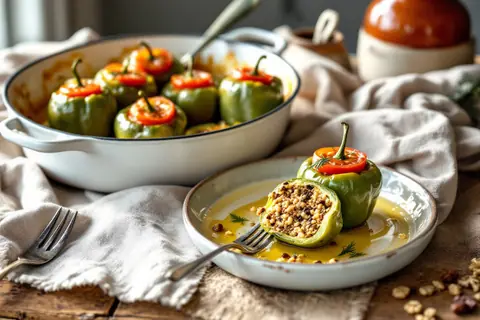
Look for the small, thin-skinned pale green peppers sold for stuffing, about the size of a fist or a bit smaller. Their walls are thin, so they soften in the same time as the filling cooks. Large bell peppers work too, but their thick walls need longer, so give them twenty minutes more or cut them in half lengthways and lay them in the pot as boats.
Which courgettes (zucchini)
Medium courgettes, about 4 cm across, are the easiest. Cut each into two pieces, about 8 cm long, and hollow them out with a corer or the handle of a teaspoon, leaving a wall about 5 mm thick and a base at one end. The round courgettes some markets sell are even better: slice off a lid and hollow them out like a cup. Chop the scooped flesh and add it to the filling or save it for an omelette.
Which tomatoes
Choose firm, medium tomatoes, ripe but not soft. A soft tomato collapses before the rice inside it is cooked. Slice off the top to make a lid, scoop out the seeds and pulp with a teaspoon, and keep that pulp: it goes into the filling and the cooking liquid, so nothing is wasted.
The filling
The filling is raw mince, raw rice, grated onion and herbs. The rice cooks inside the vegetables, drinking the juices from the meat and the broth around it. That is why the vegetables are never packed full. Uncooked rice roughly doubles as it cooks, and a vegetable stuffed to the brim will split or push its filling out over the top. Fill each one about three quarters of the way and press lightly, no more.
For the meat I use beef mince with about 15 to 20 per cent fat, or a mix of beef and lamb. Very lean mince makes a dry, crumbly filling. A spoonful of red pepper paste and one of tomato paste give the filling colour and depth; if you have never cooked with the pepper paste, the guide to biber salçası explains the hot and sweet kinds. Parsley and mint go in generously. Grated onion, rather than chopped, melts into the filling and keeps it moist.
How much filling each vegetable takes
This is the worked example I wish someone had given me the first time. Weigh your filling once it is mixed and you will know exactly how far it goes.
| Vegetable | Size | Filling per piece | Pieces | Filling used |
|---|---|---|---|---|
| Small green pepper | Fist-sized | About 65 g | 6 | 390 g |
| Courgette piece | 8 cm long, 4 cm across | About 50 g | 6 | 300 g |
| Tomato | Medium, 6 to 7 cm across | About 50 g | 6 | 300 g |
| Total | 18 | 990 g |
The filling in the recipe below comes to roughly a kilo: 500 g mince, 140 g rice, a grated onion of about 150 g, the tomato pulp and the herbs. So it fills six of each vegetable, which is eighteen pieces, enough for six people with three pieces each. If you have filling left over, roll it into small balls and tuck them into the gaps in the pot. If you run short, you over-filled the first few; take a spoonful back out.
Packing the pot
Use a wide, heavy pot with a lid, ideally one where the vegetables stand snugly upright in a single layer with a few on top. A pot that is too big lets them fall over and the filling washes out.
Stand the peppers and courgettes upright on the bottom. They need the most time and the most liquid. Put the tomatoes on top or in the gaps around the edge, where they cook more gently in the steam. Cap each vegetable with its own lid: pepper tops, tomato tops, and for courgettes a thin slice of tomato works well.
Pour the cooking liquid in down the side, never over the vegetables. It should come about two thirds of the way up the peppers. Too little and the rice on top stays hard; too much and the vegetables float and tip. Then lay a small heatproof plate upside down on top of the vegetables to keep them in place while they simmer.
Etli dolma
Recipe
Etli dolma (peppers, courgettes and tomatoes stuffed with rice and mince)
Serves 6, 18 pieces
- Prep
- 45 min
- Cook
- 55 min
- Rest
- 15 min
- Total
- 1 hr 55 min
Vegetables
- 66 small thin-skinned green peppers, tops sliced off and kept, seeds removed
- 33 medium courgettes, each cut into 2 pieces about 8 cm long and hollowed
- 66 firm medium tomatoes, tops sliced off and kept, pulp scooped out and kept
Filling
- 1 lb500 g beef mince, or beef and lamb, 15 to 20 per cent fat
- 3/4 cup140 g medium-grain rice, rinsed and drained
- 11 medium onion, grated
- 1/2 cup120 g chopped tomato pulp, from the scooped tomatoes
- 1 tbsp15 g Turkish red pepper paste (biber salçası)
- 1 tbsp15 g tomato paste
- 1/2 cup15 g flat-leaf parsley, finely chopped
- 1 tbsp3 g dried mint
- 1 1/2 tsp8 g fine salt
- 1/2 tsp1 g ground black pepper
- 1 tsp2 g pul biber (Turkish chilli flakes)
- 2 tbsp30 ml olive oil
Cooking liquid
- 2 cups480 ml hot water
- 1 tbsp15 g tomato paste
- 1/2 tsp3 g fine salt
- 2 tbsp30 g butter or olive oil
To serve
- 1 1/2 cups370 g thick plain yogurt
- 11 small garlic clove, crushed with a pinch of salt
- 2 tbsp30 g butter
- 1 tsp2 g pul biber
Method
- Prepare the vegetables: slice the tops off the peppers and tomatoes and keep them as lids, scoop out the seeds and pulp, and hollow the courgette pieces with a corer, leaving walls about 5 mm thick and a closed base.
- Chop the tomato pulp. Put half a cup of it in a large bowl and keep the rest for the cooking liquid.
- Add the mince, rice, grated onion, both pastes, parsley, mint, salt, pepper, pul biber and olive oil to the bowl and knead with your hand for 2 to 3 minutes, until evenly mixed and slightly sticky.
- Fill each vegetable about three quarters full, pressing the filling in lightly without packing it. Put the lids on.
- Stand the peppers and courgettes upright in a wide heavy pot, packed snugly, and put the tomatoes on top or in the gaps.
- Stir the hot water, tomato paste, salt and the remaining tomato pulp together and pour it down the side of the pot until it comes about two thirds of the way up the peppers. Dot the butter over the top.
- Lay a small heatproof plate upside down on the vegetables, cover the pot and bring to the boil over medium heat.
- Turn the heat to low and simmer gently for 45 to 50 minutes, until the peppers are soft when pierced and a grain of rice from the centre of a pepper is tender all the way through.
- Turn off the heat and leave the pot covered for 15 minutes, so the rice settles and the juices are partly absorbed.
- Meanwhile stir the crushed garlic into the yogurt. Just before serving, melt the butter in a small pan until foaming and stir in the pul biber.
- Serve the dolma warm with a spoonful of the pot juices, a dollop of garlic yogurt and a drizzle of the red butter.
Cook's notes
- To cook in the oven instead, pack the vegetables in a deep baking dish, add the liquid, cover tightly with foil and bake at 190°C (375°F) for about 1 hour, removing the foil for the last 10 minutes.
- Dolma reheats well in a covered pan with a splash of water over low heat for 10 to 15 minutes.
How to tell it is done
Time is a guide, not a rule, because the pot, the heat and the vegetables all vary. I check two things. First, a knife slides into the side of a pepper with no resistance. Second, I take one pepper out, open it with a fork and taste a few grains of rice from the very middle, which is the last place to cook. They should be soft right through, with no chalky centre. If they are not, add a few tablespoons of hot water if the pot looks dry and give it another ten minutes.
The liquid should have reduced to a thin, glossy sauce around the base. If there is a lot left, take the lid off for the last five minutes.
A timing plan for a one o'clock lunch
The dish has a lot of small jobs, but none of them is difficult, and most can be done while something else is happening. This is how I run the morning when people are coming at one.
| Time | Job |
|---|---|
| 10:45 | Wash the vegetables, cut the lids, hollow everything. Chop the tomato pulp. |
| 11:15 | Grate the onion, chop the herbs, mix and knead the filling. |
| 11:30 | Stuff the vegetables and pack the pot. Mix the cooking liquid and pour it in. |
| 11:45 | Bring to the boil, then lower to a gentle simmer. Lay the table. |
| 12:00 | Make the garlic yogurt and keep it in the fridge. Slice bread, make the salad. |
| 12:35 | Check a pepper and taste the rice from the centre. |
| 12:40 | Turn off the heat and leave the pot covered to rest. |
| 12:55 | Melt the butter with pul biber and bring everything to the table. |
The rest at the end is not optional. Straight from the simmer the filling is loose and very hot; after fifteen minutes under the lid it firms up and holds together when you cut into a pepper.
Variations
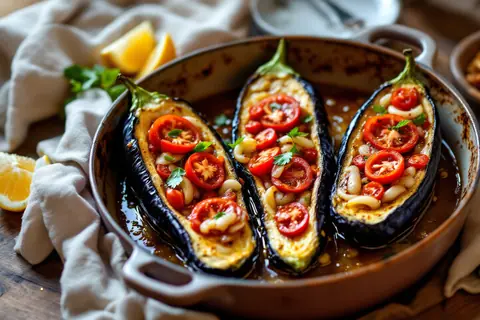
In late summer I sometimes add a few small aubergines (eggplant), halved and hollowed, which cook in about the same time as the courgettes. In winter, when the summer vegetables are tasteless, the same filling goes into cabbage leaves or into hollowed onions, both of which need a little longer.
For a meatless version for the weekday table, look at the quinoa and walnut stuffed peppers, which use a different filling entirely and are lovely at room temperature. You can also replace a third of the rice with coarse bulgur in this recipe; it gives a nuttier filling and cooks in the same time.
Some cooks in the south-east add a pinch of cumin and use more pepper paste so the filling is darker and hotter. Others in the Aegean add a handful of dill with the parsley. Both are good. Keep the meat to rice ratio the same and play with the herbs.
Make ahead, store, freeze
You can prepare the vegetables and the filling the evening before, keep them separately in the fridge and stuff them in the morning. Do not stuff them the night before; the rice draws water out of the vegetables and they go limp.
Cooked dolma keeps for three days in the fridge in a covered container with some of its juices. The flavour is often better on the second day. They freeze reasonably well for up to two months, though the tomatoes become very soft; peppers and courgettes freeze best.
What to put beside it
Dolma with yogurt is a whole meal, so the rest of the table should be light. A plate of bread for the juices, a sharp salad of cucumber, tomato and onion with sumac, and maybe a bowl of pickles. For a bigger lunch, start with a soup and finish with fruit. If you would like more stuffed things and köfte on the same table, the mains section is a good place to look.
At my mother's table, the tomatoes went first. They are the softest and the sweetest, and they come apart into the yogurt in a way nobody could resist. Put one on every plate before the children find the pot.
Filed under Mains

Bora is from İzmir and cooks the Aegean way: olive oil, vegetables, herbs and a table full of mezes. He lives in Lisbon, shops at the market most mornings and writes about dolma, salads and dishes served at room temperature.