
Piyaz: Turkish white bean salad, tahini or vinegar style
Piyaz is one of those dishes that sounds too plain to be worth a whole article: white beans, onion, parsley, something sour. Then you eat a good one and understand why people in Turkey argue about it. The beans are soft and creamy all the way through but still whole, the onion is sharp and pink with sumac, and the dressing clings to everything. It is cheap, filling and keeps well, which is why I make it nearly every week in winter here in Frankfurt.
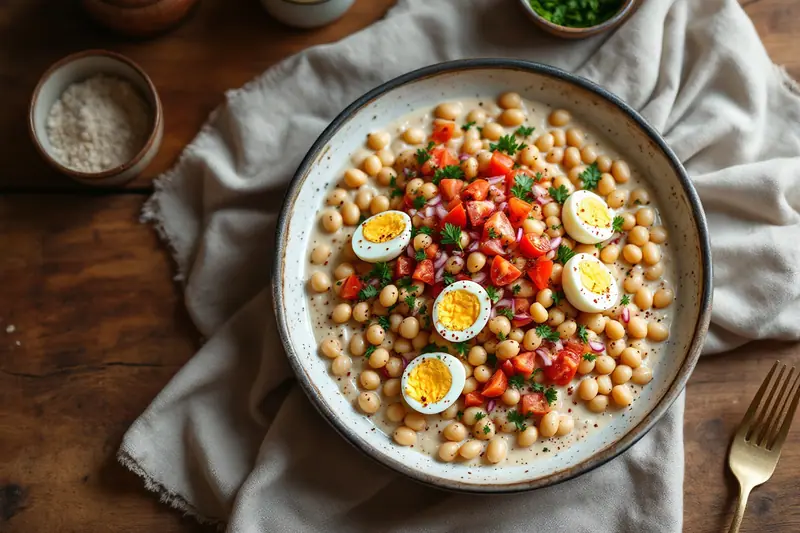
There are two main schools. In Antalya, on the south coast, piyaz comes under a thick, pale dressing of tahini, lemon, vinegar and garlic, topped with boiled egg, tomato and parsley. Elsewhere, and especially next to grilled köfte in Istanbul, piyaz is dressed simply with olive oil and vinegar so it cuts through the fat of the meat. I grew up with the second kind in Kayseri and learned the first from a neighbour who came from Antalya. I now make both, depending on what else is on the table.
This piece covers the beans first, because they decide whether your piyaz is good, then the two dressings, then a full recipe for the Antalya version with notes on switching to vinegar style.
Start with dried beans
You can make piyaz with tinned beans and it will be fine. But this is a dish where the bean is the whole point, and beans cooked from dry are creamier, hold their shape better and taste of something. They also cost far less. I buy medium white beans, the kind sold as haricot or navy beans. Larger cannellini also work, and so do the plump Turkish white beans if you can find them, though they take longer to cook.
Buy beans from a shop where the stock turns over. Old beans, the ones that have sat in a cupboard for two years, can take hours to soften and sometimes never do. If your beans look wrinkled and dull before soaking, they are probably old.
Soaking
Soak the beans overnight in plenty of cold water, at least three times their volume, because they will more than double in size. Eight to twelve hours is ideal. In a warm kitchen, put the bowl in the fridge so the beans do not start to ferment.
If you forgot to soak them, cover the beans with water, bring them to the boil for 2 minutes, then turn off the heat and leave them covered for an hour. This quick soak works well enough, though the skins split a little more often. The same soaking rules apply to chickpeas, and our guide to cooking dried chickpeas goes into more detail about soaking and water.
Cooking
Drain the soaked beans and put them in a pot with fresh water to cover by about 5 cm (2 inches). Bring them to the boil and skim off the grey foam. Then lower the heat until the water just trembles. Hard boiling bangs the beans against each other and splits their skins, and for piyaz you want them whole.
Most medium white beans take 50 to 80 minutes. I add the salt when the beans are about halfway done; that way they are seasoned right through and the skins stay tender.
Here is my texture check: take out three beans, let them cool for a minute, and squeeze each between your thumb and finger. They are ready when all three squash to a smooth paste with no chalky white centre. If even one is grainy in the middle, keep going and check again in 10 minutes. Undercooked beans are the most common fault in piyaz, and no dressing can hide them.
When they are done, turn off the heat and let the beans cool in their cooking water. This keeps the skins from wrinkling and lets the beans absorb a little more salt. Drain them only when you are ready to dress them.
How much do dried beans make?
Dried white beans roughly double and a half in weight when cooked. That makes planning easy, and it is also why cooking from dry is so economical. Here is the table I use, with the tahini dressing scaled to match.
| Servings (as a side) | Dried beans | Cooked beans (approx.) | Tahini | Lemon juice | Vinegar | Eggs |
|---|---|---|---|---|---|---|
| 3 | 125 g | 310 g | 4 tbsp | 1 1/2 tbsp | 1 tbsp | 2 |
| 6 | 250 g | 625 g | 1/2 cup (120 g) | 3 tbsp | 2 tbsp | 3 |
| 12 | 500 g | 1.25 kg | 1 cup (240 g) | 6 tbsp | 4 tbsp | 6 |
| 24 | 1 kg | 2.5 kg | 2 cups (480 g) | 3/4 cup | 1/2 cup | 12 |
A worked example: one spring I made piyaz for a community lunch of about 30 people, alongside bulgur pilaf and two other salads. As one of four dishes, people ate about half a normal side portion each, so I planned for 15 full servings. That is 250 g of dried beans times 2.5, which is 625 g dried beans. I rounded up to 650 g, cooked them the evening before in my two biggest pots, and made 1 1/4 cups of tahini dressing. There was one small bowl left over, which is exactly what you want.
One standard 400 g tin, drained, gives about 240 g of cooked beans. So the 250 g of dried beans in the recipe below replace roughly two and a half tins.
The onion
Whichever style you choose, the onion is prepared the same way. Slice a red onion into thin half-moons, put it in a bowl with a good pinch of salt and a teaspoon of sumac, and rub them together with your fingers for half a minute. The onion softens, releases some juice, loses its harsh bite and turns pink. Leave it for 10 minutes while you do everything else.
Sumac is the sour red spice made from dried berries, and you can read more about it, and about tahini, in our guide to the Turkish pantry. If you have none, a squeeze of lemon on the onion works, though it will not colour it.
Antalya style: the tahini dressing
The Antalya dressing is tahini thinned with lemon juice, vinegar and cold water, with a little crushed garlic. It should be thick enough to coat a spoon but loose enough to pour, like double cream.
Tahini behaves strangely when you add liquid. At first it seizes into a stiff, grainy paste. Keep going. Whisk in cold water a spoonful at a time and it suddenly turns smooth and pale. The final amount of water depends on your tahini, so add it gradually and stop when the texture is right.
In Antalya, the dressing usually goes on top of the beans, not mixed through, and the whole plate is finished with egg, tomato and parsley. Some cooks mix half the dressing with the beans first and pour the rest over, which is what I do: it means every bean is coated.
Vinegar style: the köfte-house piyaz
For the plainer version, toss the cooked beans with the sumac onion, a big handful of chopped parsley, 4 tablespoons of olive oil, 2 to 3 tablespoons of grape or white wine vinegar and salt. Some people add sliced boiled egg, some add tomato or a little sliced green pepper, and some keep it to just beans, onion and parsley.
This version is lighter and sharper, and it belongs next to grilled köfte, where it does the same job as pickles. It is also my choice when the rest of the meal is already rich, for example when I serve it beside a pot of kuru fasulye made from the same bag of beans. Dress it at least 20 minutes before serving so the beans absorb the vinegar.
Antalya-style piyaz
Recipe
Antalya-style piyaz (white bean salad with tahini dressing)
Serves 6 as a side, 4 as a light lunch
- Prep
- 25 min
- Cook
- 1 hr 20 min
- Rest
- 8 hr
- Total
- 9 hr 45 min
Beans
- 1 1/4 cups250 g dried white beans (haricot or cannellini), soaked overnight
- 1 tsp6 g salt
Tahini dressing
- 1/2 cup120 g tahini, well stirred
- 3 tbsp45 ml lemon juice
- 2 tbsp30 ml white wine vinegar or grape vinegar
- 1 small1 small garlic clove, crushed to a paste
- 1/2 cup120 ml cold water, or as needed
- 1/2 tsp3 g salt
Topping
- 1 medium1 medium red onion, thinly sliced into half-moons
- 1 tsp2 g sumac
- 33 eggs
- 2 medium2 medium tomatoes, diced
- 1 bunch1 bunch flat-leaf parsley, chopped
- 1 tsp2 g pul biber (Turkish red pepper flakes)
- 1 tbsp15 ml olive oil
Method
- Drain the soaked beans, put them in a pot and cover with fresh water by about 5 cm; bring to the boil and skim off the foam.
- Lower the heat so the water barely trembles and simmer for 50 to 80 minutes, adding the salt halfway, until three test beans squash to a smooth paste with no chalky centre.
- Turn off the heat and leave the beans to cool in their cooking water for at least 30 minutes, then drain well.
- While the beans cool, lower the eggs into boiling water and cook for 10 minutes, then cool them in cold water, peel and quarter.
- Rub the sliced onion with the sumac and a pinch of salt for 30 seconds and leave it for 10 minutes until soft and pink.
- For the dressing, whisk the tahini, lemon juice, vinegar, garlic and salt; it will seize and thicken.
- Whisk in the cold water a spoonful at a time until the dressing is smooth, pale and pours like double cream.
- Fold half the dressing gently through the drained beans with half the parsley, taking care not to crush them.
- Spread the beans on a wide plate and pour the remaining dressing over the top.
- Scatter over the sumac onion, tomato, eggs and remaining parsley, then warm the olive oil with the pul biber for a few seconds and drizzle it over before serving.
Cook's notes
- Keep the dressed beans and the toppings separate if making ahead; the beans keep for 2 days in the fridge, and the dressing thickens, so loosen it with a spoonful of water.
- For vinegar-style piyaz, skip the tahini dressing and toss the beans with the onion, parsley, 4 tbsp olive oil and 2 to 3 tbsp vinegar.
Storing and making ahead
Cooked, undressed beans keep for up to four days in the fridge in a little of their cooking water, and they freeze well in the same way for a couple of months. I often cook a full kilo on a Sunday, use some for piyaz and freeze the rest in 300 g bags for soups and stews.
Dressed piyaz is best eaten the day it is made. The tahini version keeps for two days, but the dressing thickens, the parsley darkens and the onion loses its bite, so add fresh parsley and loosen the dressing before serving again. The vinegar version keeps a little better and some people prefer it on the second day.
What to eat it with
Piyaz is a side dish in most homes, but the tahini version with eggs is substantial enough for lunch with bread. Next to grilled köfte or chicken, choose the vinegar version. Next to bulgur pilaf and a yogurt dish, either works. More bean dishes for the rest of the week are gathered in our grains and pulses section.
On a cold evening, I serve a plate of Antalya piyaz with a bowl of hot lentil soup and a basket of bread, and nobody asks what is for pudding.
Filed under Meze & Salads, Grains & Pulses

Nuray comes from Kayseri and now lives in Frankfurt. She writes about soups, beans, lentils and slow winter stews, with an eye on what a pantry can stretch to across a busy week.