
How to cook bulgur: fine, medium and coarse grinds explained
In my mother's kitchen in Gaziantep there were always three or four sacks of bulgur in the pantry, and nobody needed a label to tell them apart. You put your hand in, felt the grain run through your fingers, and knew whether it was for köfte, for pilaf or for soup. Here in Bristol I buy bulgur from a Turkish grocer and from a Middle Eastern shop round the corner, and the bags are far less helpful. "Bulgur wheat" on a label can mean a grain as fine as sand or one as chunky as a lentil, and the cooking method for those two is completely different. That is why so many people tell me bulgur came out like porridge, or like gravel, the first time they tried it.
So this is the long version: what bulgur is, how to read the grind, how much water each one wants, when you soak and when you simmer, and what to do when it goes wrong. Learn this once and you will never need to look at the side of a bag again.
What bulgur actually is
Bulgur is wheat that has been boiled, dried and then cracked. That order matters. Because the grain is cooked before it is broken, the starch inside is already set, and all you are really doing at home is rehydrating it and warming it through. This is why fine bulgur needs nothing more than a splash of hot water and a plate on top of the bowl, and why even the coarsest bulgur is ready in about twenty minutes.
Cracked wheat is a different thing. It is raw wheat broken into pieces without the boiling step, and it takes much longer to cook and goes gummy if you treat it like bulgur. If the bag says "cracked wheat" and not "bulgur", expect 40 minutes or more and a stickier result.
Bulgur keeps its separate grains far better than rice does, as long as you do not drown it or stir it. Those two habits cause nearly every disaster I hear about.
The grinds and what each one is for
Fine bulgur (ince bulgur, also called köftelik)
This is the grind for kısır, for çiğ köfte, for lentil köfte and for the shells of içli köfte. The grains are small, almost like semolina, and they soften completely when soaked in hot water. You never boil fine bulgur in a pot for a salad. You pour water over it, cover it, and walk away. For köfte it is soaked with very little water so that it stays sticky enough to knead and hold a shape. For kısır it gets a touch more water so the grains are tender but still separate.
Medium bulgur
Not every shop sells it, but it is useful: big enough to stay distinct, small enough to soften in a bowl. Medium bulgur works for salads where you want a little more bite than fine gives you, for stuffing peppers, and for quick pilafs when you are short of time. It can be soaked with boiling water or simmered briefly.
Coarse bulgur (pilavlık)
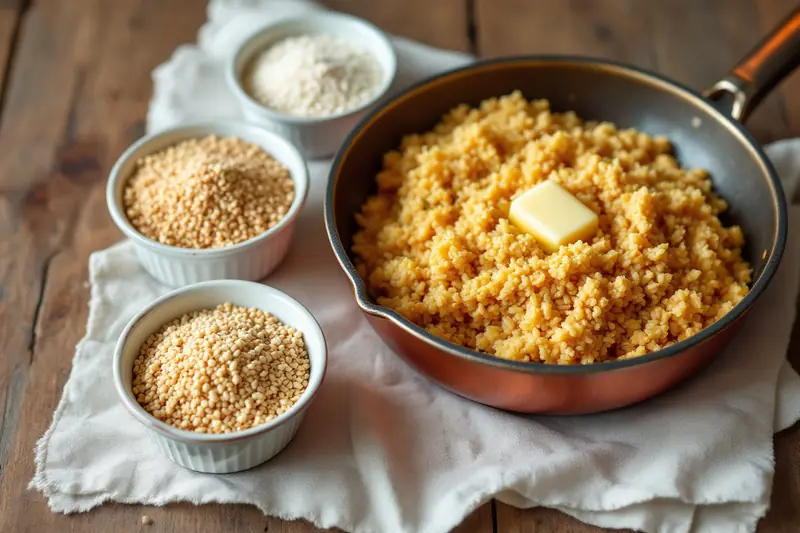
The everyday pilaf grain, roughly the size of a grain of couscous or a little larger. It needs a short simmer and a rest. This is the bulgur for plain pilaf, for vegetable bulgur pilaf and for bulgur pilaf with chickpeas. If you only keep one bulgur in the house, keep this one.
Whole-kernel bulgur (başbaşı)
The kernel is cracked only lightly or not at all, so each grain is plump and chewy. It takes the most water and the longest time, and it is lovely in hearty pilafs with meat or in stuffings where you want the grain to hold its own. It is also less forgiving if your lid is loose, so read the simmering notes below.
The ratio table
These are the ratios I use, by volume, with any cup you like as long as you use the same cup for the grain and the water. The liquid can be water or stock; stock gives a richer pilaf, water gives a cleaner taste for salads.
| Grind | Liquid per 1 cup bulgur | Method | Time on the heat | Rest | Best for |
|---|---|---|---|---|---|
| Fine (köftelik) for köfte | 1/2 to 2/3 cup just-boiled water | Soak, covered | none | 15 to 20 min | Çiğ köfte, lentil köfte, içli köfte shells |
| Fine (köftelik) for salad | 3/4 to 1 cup just-boiled water | Soak, covered | none | 15 to 20 min | Kısır, tabule |
| Medium | 1 1/4 to 1 1/2 cups | Soak or simmer | 6 to 8 min | 10 min | Salads, stuffed peppers, quick pilaf |
| Coarse (pilavlık) | 1 3/4 to 2 cups | Fry, then simmer | 12 to 15 min | 10 to 15 min | Pilaf, side dishes |
| Whole kernel (başbaşı) | 2 1/4 to 2 1/2 cups | Fry, then simmer | 20 to 25 min | 15 min | Hearty pilaf, stuffing |
One cup of dry bulgur, about 170 g, gives roughly 2 1/2 to 3 cups once cooked, depending on the grind. That is enough as a side for three or four people.
The ranges are there for a reason. Bulgur from different harvests and mills absorbs a little differently, and a wide shallow pan loses more steam than a tall narrow one. Start at the lower figure the first time you open a new bag. You can always add a few spoonfuls of boiling water at the end; you cannot take water out.
Soak or simmer?
Here is the simple rule. If the grain is small enough that it softens in a covered bowl within 20 minutes, soak it. If it is not, simmer it.
Soaking is for fine bulgur and sometimes medium. Use water that has just come off the boil, pour it over the grain, stir once so there are no dry pockets, then cover the bowl tightly with a plate or a lid. After 15 minutes, press a few grains between your finger and thumb. They should squash flat with no hard white centre. If the water is all gone and the grain is still firm, add two tablespoons more boiling water, cover and wait five minutes.
For kısır I mix the pepper paste into the bulgur while it is still warm from soaking. The warm grain takes up the paste and turns an even red, which never happens once it has cooled.
Simmering is for coarse and whole-kernel bulgur. And before you simmer, you fry.
The coarse bulgur method, step by step
Fry the grain first
Melt butter (or butter with a little oil so it does not burn) and add your onion, then the bulgur. Stir the dry grain in the fat for two or three minutes until it smells nutty and every grain is glossy. This coats the outside, which helps each grain stay separate, and it gives the pilaf a toasted depth. If you are adding tomato or pepper paste, fry it for a minute before the bulgur goes in so it loses its raw edge.
Add hot liquid, not cold
Pour in liquid that is already boiling. Cold water stops everything, the fat seizes, and the grains on the bottom sit and soak while the top ones wait. Hot liquid keeps the pan at a simmer from the first second.
Cover, turn down and leave it alone
Once it is bubbling, put the lid on, turn the heat to the lowest setting and set a timer. Do not stir. Do not lift the lid to look. Stirring breaks the grains and releases starch, and that starch is what turns a pilaf into a mush. You will hear it: a soft crackle when the liquid is nearly gone. Tilt the pan very slightly; if no liquid runs to the edge, it is ready.
The towel rest
Turn off the heat, lift the lid, lay a clean tea towel or a couple of sheets of kitchen paper over the pan, and put the lid back on top. Leave it for 10 to 15 minutes. The towel catches the steam that would otherwise drip back down as water, so the grains finish cooking in dry heat and stay fluffy. My mother would fold the corners of the towel up over the lid so they did not catch on the hob, and I do the same. Then fluff it with a fork, never a spoon.
The recipe: plain bulgur pilaf with butter and onion
This is sade bulgur pilavı, the plain one that goes with almost everything. Once you can make this, every other bulgur pilaf is the same method with something added.
Recipe
Plain bulgur pilaf with butter and onion (sade bulgur pilavı)
Serves 6 as a side, 4 as a main with yogurt
- Prep
- 10 min
- Cook
- 20 min
- Rest
- 15 min
- Total
- 45 min
Pilaf
- 2 tbsp30 g butter
- 1 tbsp15 ml olive oil or sunflower oil
- 1 medium1 medium onion, finely chopped
- 1 tbsp15 g Turkish red pepper paste (biber salçası) or tomato paste, optional
- 2 cups340 g coarse bulgur (pilavlık)
- 3 1/2 to 4 cups840 to 960 ml boiling chicken or vegetable stock, or water
- 1 tsp5 g salt, less if the stock is salted
- 1/2 tsp1 g freshly ground black pepper
Method
- Melt the butter with the oil in a heavy pan with a tight lid over medium heat.
- Add the onion and cook for 5 to 6 minutes, stirring now and then, until soft and just turning golden at the edges.
- If using pepper or tomato paste, stir it in and fry for 1 minute until it darkens slightly and smells sweet.
- Add the bulgur and stir for 2 to 3 minutes until every grain is coated and it smells toasty.
- Pour in 3 1/2 cups of the boiling stock, add the salt and pepper, stir once and bring back to a lively bubble.
- Cover, turn the heat to its lowest setting and cook for 12 to 15 minutes without stirring or lifting the lid.
- Check by tilting the pan: if liquid still runs to the edge, cover and give it 2 to 3 minutes more; if the grain tastes firm and the pan is dry, sprinkle over 3 to 4 tbsp of the remaining boiling stock and cover again.
- Turn off the heat, lay a clean tea towel over the pan, replace the lid and rest for 10 to 15 minutes.
- Fluff gently with a fork, taste for salt and serve warm.
Cook's notes
- Use the lower amount of stock the first time you cook from a new bag of bulgur, then adjust next time.
- A handful of şehriye (short vermicelli) fried golden in the butter before the onion is a classic addition.
Why your pilaf went mushy, and other problems
Almost every bulgur failure comes down to a short list of causes. Go through them in order.
Too much water
The most common one by far. Recipes written for rice often call for twice the volume of liquid, and some bulgur needs less than that. If your pilaf is wet and soft, cut the liquid by a quarter next time.
Stirring
Every stir breaks a few grains and releases starch. Stir once when the liquid goes in, then not again until the fork at the end.
The wrong grind
Fine bulgur simmered in a pot will turn into a paste in minutes. If your "pilaf" bulgur looks like sand, soak it and make a salad instead.
Skipping the fry
Unfried bulgur clumps more. Two minutes in fat makes a real difference.
Skipping the rest
Pilaf served straight from the heat is wetter at the bottom and drier at the top. The rest evens it out.
It is still crunchy
Either the heat was too high and the liquid boiled off before the grain softened, or the lid let steam out. Sprinkle over three or four tablespoons of boiling water, cover tightly, keep it on the lowest heat for five minutes, then rest it again. A sheet of foil under the lid fixes a loose fit.
It stuck on the bottom
The heat was not low enough, or your pan is thin. Do not scrape the burnt layer into the rest. Spoon the good pilaf off the top into a clean dish. Next time use a heavier pan or put a heat diffuser under it.
It is bland
Bulgur needs salt in the cooking liquid, not sprinkled on at the end. About 1/2 teaspoon per cup of dry grain if you are using water.
A note on links: the box below points to a partner shop or service. If you buy or sign up through it, Duru Lezzetler may earn a commission at no extra cost to you. Partners never see or shape our recipes.
Cooking for a crowd: a worked example
For a family lunch of twelve, with bulgur as the main side next to meat or beans, I plan on about 1/3 cup of dry coarse bulgur per person. That gives:
- 12 people × 1/3 cup = 4 cups of dry coarse bulgur, about 680 g
- Liquid at 1 3/4 cups per cup of bulgur = 7 cups, about 1.7 litres
- Butter scaled up to 60 g, two large onions, salt about 2 teaspoons if using water
Two things change when you scale up. First, use the lower end of the liquid range, because a big pot holds steam better and less evaporates. Second, use the widest heavy pan you have, or split it between two pans. A deep narrow pot full of bulgur cooks unevenly: the bottom goes soft before the top is tender. With 4 cups in one wide pan, give it 15 minutes on the lowest heat and a full 15 minutes of rest.
Storing and reheating bulgur
Cooked bulgur keeps for three to four days in a covered container in the fridge. To reheat pilaf, put it in a pan with a tablespoon of water and a small piece of butter, cover, and warm it over low heat for five to six minutes, shaking the pan once. In the microwave, sprinkle it with water and cover the bowl.
Cooked bulgur also freezes well for up to three months in flat bags. Thaw it in the fridge and reheat it the same way.
Soaked fine bulgur for salads is best eaten within two days.
Testing a new bag
Dry bulgur keeps for months in a jar with a good lid, away from heat and light, but smell it before you cook from an old bag. Wheat that smells dusty or stale will taste of it. When I am unsure about a new bag, I cook a quarter cup of it with half a cup of water in a small covered pan, taste it after ten minutes, and write the timing on the bag with a marker. It takes a few minutes and saves a whole pot.
Filed under Grains & Pulses, Kitchen Notes

Ayla grew up in a Gaziantep family kitchen where bulgur came in four sizes and köfte was kneaded by feel. She lives in Bristol and writes about pilafs, kısır, köfte and the pepper pastes that hold them together.