
Mushroom bulgur pilaf with thyme and butter
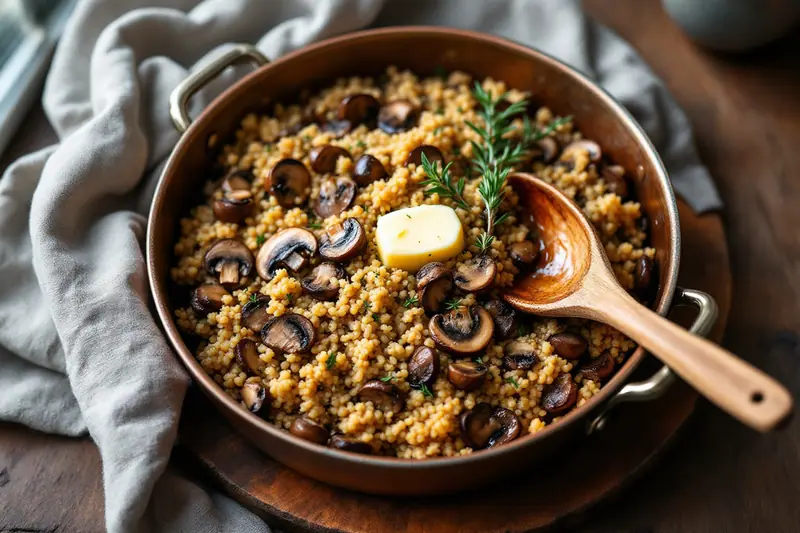
Mantarlı bulgur pilavı is the pilaf I make on the evenings when the fridge is nearly empty and the cupboard is not. A bag of coarse bulgur, an onion, a box of mushrooms, some butter and a few sprigs of thyme: forty minutes later there is a pan of something savoury and filling that can be dinner by itself with a bowl of yogurt, or a side for chicken.
It is also a dish that goes wrong in a very specific way. Most versions I was served growing up were pleasant but grey: the mushrooms were stirred into the pot with the bulgur, they released their water, and they ended up soft and pale, tasting more boiled than anything. So one weekend in our Rotterdam kitchen I cooked the pilaf three ways, side by side, to see what actually makes the difference.
The side-by-side test
Same bulgur, same stock, same amount of mushrooms and butter in each pan. Only the handling of the mushrooms changed.
| Method | What happened | Verdict |
|---|---|---|
| A. Mushrooms sliced and added raw with the bulgur and stock | Mushrooms released water into the pot, bulgur came out slightly wet, mushrooms soft and pale | Edible, flat flavour |
| B. Mushrooms fried with the onion, then bulgur and stock added | Better colour, but crowded pan meant they steamed for the first 8 minutes before browning | Good, a little soggy |
| C. Mushrooms browned hard in batches in a dry-ish hot pan, set aside, pilaf built in the same pan, mushrooms folded back in at the end | Deep brown edges, meaty texture, browned bits in the pan flavoured the bulgur | Clear winner |
Method C takes about ten minutes longer and one extra plate. The difference in taste is large enough that I have not gone back. Browning creates flavour that boiling never will, and the brown film left in the pan dissolves into the stock and seasons every grain of bulgur.
Which bulgur
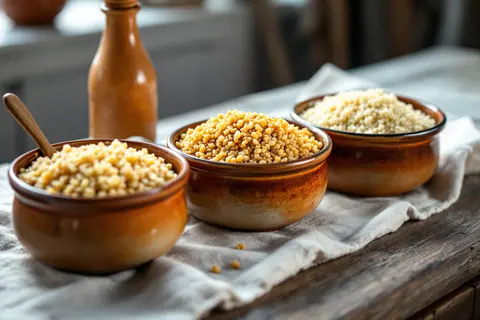
Use coarse bulgur, the kind sold for pilaf (pilavlık bulgur). Each grain is about the size of a lentil cut in half. Fine bulgur, the kind for kısır and köfte, cooks into porridge in a pilaf. There is also an extra-coarse type with whole cracked kernels, which works but needs a few more minutes and a little more liquid. For a longer explanation of grain sizes and how each behaves, see the guide on how to cook bulgur.
You do not need to rinse bulgur. It has been parboiled and dried already, so it is clean, and washing it only makes it harder to toast.
The ratio, measured
Coarse bulgur takes up roughly twice its volume in liquid, but mushrooms change the sum slightly, because even well-browned ones give up a little water as they sit in the hot pilaf. I tested 1 cup of bulgur to 2 cups of stock and to 1 3/4 cups. With browned mushrooms folded in at the end, 1 3/4 cups gave separate, tender grains; the full 2 cups was a touch soft.
So for this pilaf: 1 1/2 cups (255 g) coarse bulgur to 2 2/3 cups (640 ml) hot stock. The stock must be hot when it goes in. Cold liquid stops the cooking, and the grains on the bottom go soft while the top ones stay hard.
Thyme and butter
Fresh thyme is best here. Strip the leaves from about six sprigs and add half with the onions so they flavour the fat, and half at the end for freshness. Dried thyme works too, about a teaspoon, all of it added with the onion. Wild thyme (kekik), the kind sold dried in Turkish shops, is stronger, so use a little less.
The butter does two jobs. Some goes in at the start with a spoonful of oil, which stops it burning while the onions cook. The rest goes on top of the hot pilaf right before it rests, where it melts down through the grains and gives the dish its gloss.
Resting under a towel
When the stock is absorbed, the bulgur is not finished. Take the pan off the heat, lift the lid, put a clean tea towel over the pan and press the lid back on. Leave it for ten minutes. The towel catches the steam that would otherwise drip back onto the pilaf, so the grains stay separate instead of turning sticky on top. This is the same trick Turkish cooks use for rice pilaf, and it works just as well here.
Recipe
Mantarlı bulgur pilavı (mushroom bulgur pilaf with thyme)
Serves 4 as a main, 6 as a side
- Prep
- 15 min
- Cook
- 30 min
- Rest
- 10 min
- Total
- 55 min
Mushrooms
- 1 lb450 g chestnut or button mushrooms, thickly sliced
- 2 tbsp30 ml sunflower or olive oil
- 1/2 tsp3 g fine salt
Pilaf
- 2 tbsp30 g butter, for cooking
- 1 tbsp15 ml sunflower or olive oil
- 1 large1 large onion, finely chopped
- 11 long green pepper, chopped (optional)
- 2 cloves2 cloves garlic, finely chopped
- 6 sprigs6 sprigs fresh thyme, leaves stripped (or 1 tsp dried)
- 1 tbsp15 g Turkish pepper paste or tomato paste (optional)
- 1 1/2 cups255 g coarse bulgur
- 2 2/3 cups640 ml hot vegetable or chicken stock
- 1 tsp6 g fine salt, less if the stock is salty
- 1/2 tsp1/2 tsp black pepper
- 1 tbsp15 g butter, to finish
Method
- Heat 1 tbsp oil in a wide, heavy pan over high heat until it shimmers. Add half the mushrooms in one layer and leave them untouched for 3 minutes, until browned underneath.
- Stir, cook 2 to 3 minutes more until browned all over, then tip onto a plate. Repeat with the remaining oil and mushrooms, then season them all with 1/2 tsp salt.
- Lower the heat to medium, add the butter and 1 tbsp oil to the same pan, then the onion and green pepper. Cook for 6 to 8 minutes, scraping up the brown bits, until soft and golden.
- Add the garlic, half the thyme and the pepper or tomato paste, if using, and stir for 1 minute until fragrant.
- Add the bulgur and stir for 2 minutes so every grain is coated and smells lightly toasted.
- Pour in the hot stock, add the salt and black pepper and bring to a boil. Cover, turn the heat to the lowest setting and cook for 15 minutes.
- Check that the liquid has gone: tilt the pan, and there should be no stock pooling at the edge, with small steam holes across the surface.
- Scatter the browned mushrooms and the rest of the thyme over the top, add the finishing butter in small pieces and turn off the heat.
- Cover the pan with a clean tea towel, press the lid on top and leave to rest for 10 minutes.
- Fork the mushrooms gently through the bulgur, taste for salt and serve.
Cook's notes
- Do not salt the mushrooms until they are browned; salt draws out water and stops them colouring.
- Leftovers keep for 3 days in the fridge. Reheat with a splash of water in a covered pan over low heat.
How to tell it is right
After the rest, take a spoonful from the middle of the pan and look at it closely. Each grain of bulgur should be plump and separate, with a slight chew at the centre, a bit like al dente pasta. If the grains stick together in clumps and feel pasty, there was too much liquid or the pan was stirred while it simmered. If they are hard and dry in the middle, sprinkle over three or four tablespoons of hot stock, cover with the towel and lid again and give it another ten minutes off the heat. The mushrooms should still have browned edges and some bounce when you bite them. If they have gone limp, they were added too early.
Scaling it
The pilaf doubles cleanly for eight people if your pan is wide enough. The thing that does not scale is the mushroom browning: 900 g of mushrooms in one pan will steam. Brown them in four batches, or spread them on two oiled trays and roast them at 220°C (425°F) for 20 to 25 minutes, turning once, while you build the pilaf on the stove. For the doubled batch the numbers are 510 g (3 cups) bulgur and 1.28 litres (about 5 1/3 cups) of stock, and the simmering time stays at 15 minutes.
Variations I have tested
- With chickpeas: add a cup of cooked chickpeas with the stock. Same timing. If you like the idea, the chickpea bulgur pilaf builds the whole dish around them.
- With vermicelli: toast two tablespoons of broken vermicelli in the butter before the onion goes in, as you would for rice pilaf.
- Mixed mushrooms: a handful of oyster or shiitake mushrooms among the chestnut ones adds a chewier texture. Dried porcini, soaked in some of the hot stock and chopped, give it a woodier depth; add the soaking liquid as part of the stock.
- More vegetables: for a pilaf built around peppers and tomatoes instead, try the vegetable bulgur pilaf.
What to serve with it
On its own, I eat it with thick yogurt spooned on the side and a salad of tomato, cucumber and onion. As a side it goes with roast chicken, grilled köfte or a pan of white beans. Leftovers are good cold the next day at lunch, with a squeeze of lemon and some chopped parsley stirred through, which turns it into something close to a grain salad.
Filed under Grains & Pulses

Murat's family is from the Black Sea coast; he lives in Rotterdam. He likes to test things side by side: soaking times, oven temperatures, bread doughs, chickpeas cooked five ways, and the weeknight plans that come out of it.