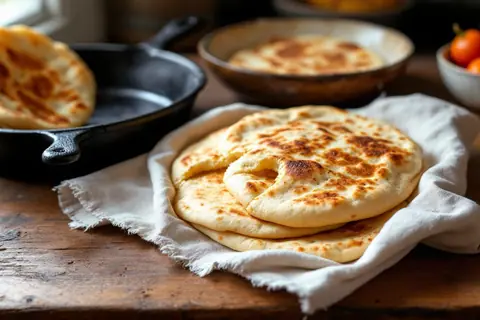

Bulgur bread: a soft loaf with soaked fine bulgur
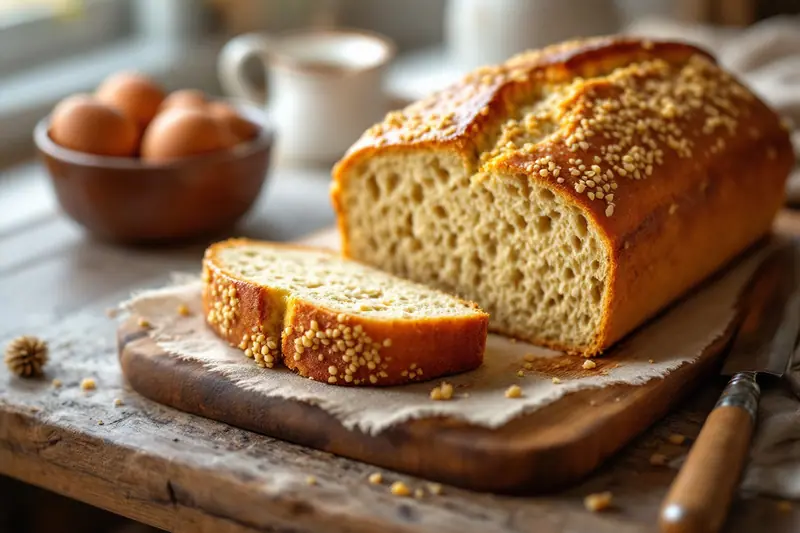
Bulgur ekmeği, bread with bulgur in it, is an old thrifty habit in Turkish homes: a few spoonfuls of grain left over from the pilaf jar end up in the dough, and the loaf comes out softer, nuttier and slower to go stale. I started making it on purpose after a side-by-side test in my kitchen in Rotterdam. Two loaves from the same dough, one plain and one with soaked bulgur, left on the counter under a cloth. On the third morning the plain one was dry at the edges. The bulgur loaf still toasted like the first day.
The trick is not complicated, but it has a name: a soaker. You pour boiling water over fine bulgur and let it swell before it goes into the dough. Dry bulgur thrown straight into dough behaves like grit. It steals water from the flour while the bread rises, then bakes into hard specks. Soaked bulgur does the opposite. It brings moisture with it and gives some back during baking.
Why fine bulgur and not coarse
Use fine bulgur, the kind sold for kısır and köfte (köftelik bulgur). It softens completely in 30 minutes of soaking with no cooking. I tried coarse pilaf bulgur the same way and the grains were still chewy, almost crunchy, in the finished loaf. Some people like that. If you do, simmer coarse bulgur in its water for 10 minutes before using it, then cool it. The notes on how to cook bulgur explain the grain sizes properly.
The soaker: weights and timing
The ratio is 100 g fine bulgur to 150 ml boiling water. That is roughly 1 part grain to 1.5 parts water by weight, and almost all of it is absorbed. Stir, cover with a plate, and leave for 30 minutes. It must cool to warm before it meets the yeast. If it still feels hot on the back of your finger, spread it out on a plate for 5 minutes.
What you want at the end is a damp, fluffy mass, not soup. If there is water pooled at the bottom of the bowl, your bulgur was finer than mine or very fresh. Pour off the excess rather than adding it to the dough, or the dough will be slack.
Hydration, tested three ways
This is where I spent most of my time. On paper the dough looks very stiff: 400 g bread flour and only 220 ml water, which is 55 percent hydration. But the soaker brings another 150 g of water, and that changes the arithmetic.
Here is the full sum. Total water is 220 + 150 = 370 g. Total dry grain is 400 + 100 = 500 g. That is 74 percent on paper. In practice the bulgur holds on to most of its water, so the dough feels like an ordinary sandwich dough of around 62 to 65 percent.
I baked the same recipe with three amounts of added water:
| Added water | Dough feel | Loaf |
|---|---|---|
| 200 ml | Firm, hard to knead in the bulgur | Tight crumb, a little dry, low rise |
| 220 ml | Soft, slightly tacky, smooth after kneading | Even crumb, good dome, soft |
| 250 ml | Sticky, spreads when shaped | Big holes under the crust, flat top |
So 220 ml is my number with strong white bread flour. If you use plain flour with less protein, drop to 200 to 210 ml. If you swap 100 g of the flour for wholemeal, add 15 ml more water, because bran drinks.
Kneading and the first rise
Mix the flour, yeast and salt first, then add the water, honey, oil and soaker all at once. It will look shaggy and lumpy for the first two minutes. Keep going. By hand it needs about 10 minutes of kneading; in a stand mixer with a dough hook, 6 minutes on a low speed. The bulgur makes it hard to judge the usual stretch test, because the grains tear the dough when you pull it thin. I look for a different sign: the dough should feel smooth between the grains, spring back slowly when pressed, and no longer stick to a clean, dry hand.
The first rise takes 60 to 75 minutes in a warm kitchen of around 24°C (75°F). The dough should roughly double. In a cool room it can take 2 hours, and that is fine. Slow rising tastes better anyway.
Shaping for a loaf tin
A loaf tin makes this bread easy. The soft dough does not need to hold its own shape, and the slices come out square, which is what you want for toast. Use a 900 g (2 lb) tin, about 23 x 13 cm. Brush it with oil.
Press the risen dough into a rectangle as wide as the tin is long. Roll it up tightly from the short side, pinch the seam, and lay it seam side down in the tin. Brush the top with water and scatter over a spoonful of dry fine bulgur or sesame seeds, pressing them on lightly. Cover and leave for 40 to 50 minutes, until the dome rises 1 to 2 cm above the rim. Press gently with a floured finger: if the dent fills back slowly, it is ready.
Recipe
Bulgur ekmeği (bulgur bread in a loaf tin)
One 900 g (2 lb) loaf, about 16 slices
- Prep
- 30 min
- Cook
- 35 min
- Rest
- 3 hr 30 min
- Total
- 4 hr 35 min
Soaker
- 1/2 cup + 1 tbsp100 g fine bulgur (köftelik bulgur)
- 1/2 cup + 2 tbsp150 ml boiling water
Dough
- 3 1/4 cups400 g strong white bread flour
- 2 1/4 tsp7 g instant dried yeast
- 1 1/2 tsp8 g fine salt
- scant 1 cup220 ml lukewarm water
- 1 tsp7 g honey or sugar
- 2 tbsp30 ml olive oil, plus a little for the tin
- 1 tbsp10 g dry fine bulgur or sesame seeds, for the top
Method
- Pour the boiling water over the fine bulgur, stir, cover with a plate and leave for 30 minutes until all the water is absorbed and the grain is soft; let it cool to warm.
- Mix the flour, yeast and salt in a large bowl, then add the lukewarm water, honey, olive oil and the soaked bulgur.
- Stir into a shaggy dough, then knead on the worktop for about 10 minutes until smooth between the grains, springy and no longer sticky to a dry hand.
- Put the dough in an oiled bowl, cover and leave in a warm place for 60 to 75 minutes until roughly doubled.
- Oil a 900 g (2 lb) loaf tin, press the dough into a rectangle, roll it up tightly from the short side and lay it seam side down in the tin.
- Brush the top with water, scatter over the dry bulgur or sesame and press it on lightly.
- Cover and prove for 40 to 50 minutes, until the dome stands 1 to 2 cm above the rim; heat the oven to 200°C (400°F) during this time.
- Bake for 35 minutes until deep golden; the loaf should sound hollow when tapped underneath, or read about 95°C (203°F) inside.
- Turn out onto a rack at once and leave to cool for at least 1 hour before slicing.
Cook's notes
- For a part-wholemeal loaf, swap 100 g of the bread flour for wholemeal and add 15 ml more water.
- If the top browns too fast after 20 minutes, lay a sheet of foil loosely over it for the rest of the bake.
Baking and cooling
A hot oven at 200°C (400°F) for 35 minutes gives a deep golden crust that is still soft enough for sandwiches. If your oven runs hot, check at 30 minutes. The most reliable test is a probe thermometer pushed into the middle from the side: 95°C (203°F) means it is done. Without one, turn the loaf out and knock on the bottom. It should sound hollow, not dull.
Take the loaf out of the tin straight away, or the bottom steams and goes soggy. Then wait. I know it is hard. Bulgur bread is moister than plain bread, and if you cut it warm the crumb looks gummy and the knife drags. After an hour on a rack it slices cleanly.
Keeping it
Wrapped in a cloth or a paper bag, the loaf keeps well for three to four days at room temperature, which is a day longer than my plain white loaf from the same tin. For longer, slice it once it is cold and freeze the slices in a bag. They toast straight from the freezer in 3 to 4 minutes.
What to eat it with
This is a breakfast bread first. Toast it and serve with white cheese, olives, tomatoes and a pot of tea, or dip it into the pan of menemen while the eggs are still soft. It makes good sandwiches with leftover köfte. And a slice next to a bowl of kısır at lunch is a lot of bulgur in one meal, but nobody in my house has complained yet.
Variations I have tested
Replacing the honey with a tablespoon of grape pekmez gives a darker crumb and a faint malt flavour. A teaspoon of nigella seeds kneaded in at the end is very good with cheese. Adding 2 tablespoons of mild red pepper paste to the water turns the dough orange and gives a gentle savoury note, which children seem to like. I tried adding a handful of chopped walnuts, and they worked, but they made the loaf heavier and needed 5 minutes more in the oven.
Filed under Breads & Pastries, Grains & Pulses

Murat's family is from the Black Sea coast; he lives in Rotterdam. He likes to test things side by side: soaking times, oven temperatures, bread doughs, chickpeas cooked five ways, and the weeknight plans that come out of it.