Bazlama: soft Turkish pan flatbread with a yogurt dough
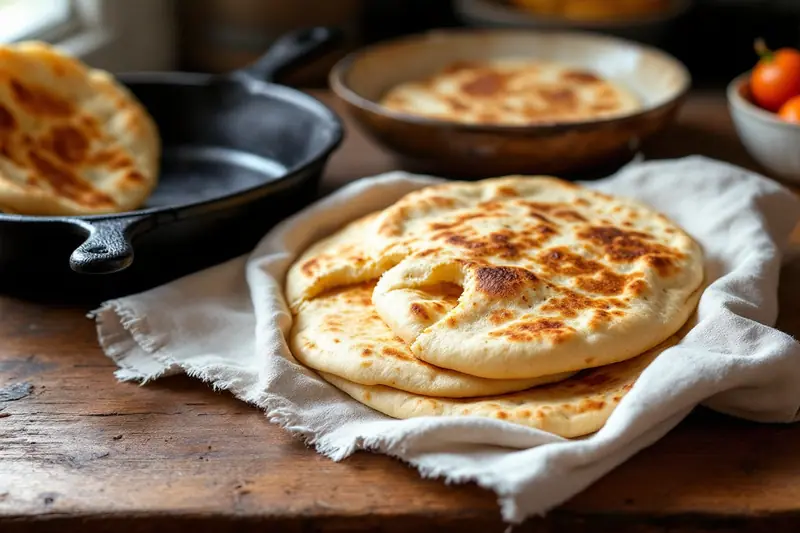
Bazlama is the bread you make when there is no oven, or no time to heat one. It is a round of soft yogurt dough, about as thick as your finger, cooked on a dry pan until it puffs up, takes on a few golden brown patches and turns into something halfway between a pitta and a crumpet. In villages across Anatolia it was cooked on a sac, a wide domed iron plate set over a fire. In my kitchen in Rotterdam it is cooked in a heavy frying pan on a gas ring, and it comes out very well.
My family is from the Black Sea coast, which is cornbread country, so bazlama was not something I grew up making. I learned it as an adult, and that is probably why I approached it the way I approach most things: I made it several different ways on the same morning and compared them on a board. This piece is the result of those comparisons. The recipe at the end is the version that won, but the reasons matter more than the quantities, because once you know why bazlama behaves the way it does you can make it with whatever flour and pan you have.
What good bazlama looks like
Before testing anything I needed a target. A good bazlama is 1.5 to 2 cm thick when cooked. The outside is matt and floury, with a scatter of brown freckles on both faces and pale, soft sides. When you tear it, it should open with a slight stretch, not snap, and the inside should be full of small and medium holes, moist but not gummy. It should smell faintly sour and wheaty. And it should still be soft an hour after cooking, which is where a lot of flatbreads fail.
A bazlama is not crisp. If yours has a crust you could tap with a knuckle, the pan was too cool and it cooked too long, or the dough was too dry. Keep that in mind; it comes up again below.
Test one: yogurt against water
The first question was whether yogurt really earns its place. I made two doughs from the same flour, both with yeast, both at the same hydration. One used 250 g plain whole-milk yogurt plus 150 ml water. The other used 360 ml water only, which is roughly the same total water, since yogurt is mostly water anyway. Same salt, same oil, same rise time, same pan.
The differences were clear. The yogurt dough was softer and silkier under my hands, and less sticky despite holding the same amount of water. It rose a little faster in the first half hour. In the pan it browned more evenly and earlier, in a pattern of small freckles rather than a few big dark patches. After cooling for an hour, the yogurt bread was still soft and tore cleanly. The water bread had gone slightly leathery at the edges and tasted flat next to it.
The yogurt does three useful things. Its acidity softens the gluten a little, so the bread is tender instead of chewy. Its milk sugars and proteins help browning at a lower heat. And the fat in whole-milk yogurt slows down staling. Low-fat yogurt worked, but the bread was a touch drier. Strained, very thick yogurt needs extra water, otherwise the dough is too stiff to puff.
Test two: yeast against no yeast
Plenty of home cooks make a quick bazlama with no yeast at all, leaning on baking powder and the acid in the yogurt. It is tempting on a weekday morning, so I made one of those alongside the yeasted dough: same flour, same yogurt, 2 teaspoons of baking powder instead of yeast, a 20-minute rest instead of an hour's rise.
The quick bread was good. I want to say that plainly, because the internet tends to be snobbish about it. It puffed in the pan, browned well and was soft enough to fold around cheese. But the crumb was finer and more cake-like, more like a thick pancake than bread, and it had a faint baking powder taste that the yogurt only partly hid. By the next day it was firm and needed reheating to be pleasant.
The yeasted dough had bigger, uneven holes, a proper bready stretch and a gentle sour depth. It also reheated much better from the freezer. My conclusion: use yeast whenever you can wait an hour. Use the baking powder version when you cannot, and eat it straight away.
Test three: the heat of the pan
This was the test that changed my results most. I used a surface thermometer, the kind that reads a pan with an infrared beam, and cooked one round of the same dough at three settings.
| Pan surface | What happened | Verdict |
|---|---|---|
| About 180°C (350°F) | Barely puffed, pale, took 5 minutes a side, dry and crusty | Too cool |
| About 220°C (430°F) | Puffed within 90 seconds, even freckles, 2 to 3 minutes a side | Right |
| About 260°C (500°F) | Black spots in 40 seconds, raw doughy centre | Too hot |
Without a thermometer, here is how to read the pan. Heat it on medium for a full 4 minutes. Flick a few drops of water on it: they should skitter and vanish in 2 or 3 seconds. If they sit and boil, it is too cool. If they vanish instantly with a hiss, turn the heat down a notch and wait a minute.
The reason heat matters so much is the puff. Bazlama rises in the pan because the surface sets quickly while steam and gas expand inside. If the pan is too cool, the dough dries before it can expand, and you get the crusty, flat result. Too hot, and the outside sets and burns before the heat reaches the middle.
A heavy pan helps. Cast iron holds its heat when the cold dough goes in; a thin non-stick pan drops in temperature and then overshoots. If you only have a thin pan, cook on slightly lower heat and give it longer to recover between breads.
Flour and the feel of the dough
Ordinary plain flour (all-purpose flour) makes very good bazlama. Bread flour makes it chewier and slightly harder to roll, which I did not prefer. A mix of 400 g plain flour and 100 g wholemeal gives a nutty bread that still puffs well, though it needs about 30 ml more water.
The dough should be soft and slightly tacky after kneading, the feel of a ripe peach rather than modelling clay. Knead for 6 to 8 minutes by hand, until it is smooth and springs back slowly when poked. It does not need the long, hard kneading of a tin loaf. If you are used to the denser bulgur bread, expect this dough to be much looser.
Shaping and cooking
Divide the risen dough into 8 pieces of about 115 g each and roll them into balls. Let them rest under a cloth for 15 minutes, which relaxes the gluten so they do not shrink back. Then flatten each one with floured fingers, or a rolling pin, to a round about 15 cm across and 1 cm thick. Do not go thinner: bazlama is meant to be thick.
The cooking rhythm goes like this. Lay the round in the hot dry pan. After about a minute small bubbles form on top and the edges look slightly dry. Flip it. The cooked side should have pale gold freckles. Now the bread starts to puff, sometimes in one big dome, sometimes in a few blisters. After another minute flip it back, and give each side a final 30 to 60 seconds until both faces are freckled brown.
The last step is the one people skip. Stack the hot breads in a clean tea towel and fold it over. The trapped steam softens the outside. Ten minutes in the towel is the difference between a soft bazlama and a crusty one.
Bazlama for eight
Recipe
Bazlama (Turkish yogurt pan flatbread)
Makes 8 flatbreads, about 15 cm across
- Prep
- 25 min
- Cook
- 30 min
- Rest
- 1 hr 15 min
- Total
- 2 hr 10 min
Dough
- 4 cups500 g plain flour (all-purpose flour), plus extra for shaping
- 2 tsp7 g instant dried yeast
- 1 tsp5 g sugar
- 1 1/2 tsp9 g fine salt
- 1 cup250 g plain whole-milk yogurt, at room temperature
- 2/3 cup150 ml lukewarm water
- 2 tbsp30 ml olive oil or sunflower oil
To serve (optional)
- 2 tbsp30 g soft butter, for brushing
Method
- Mix the flour, yeast, sugar and salt in a large bowl, then add the yogurt, water and oil and stir into a shaggy dough.
- Knead on a lightly floured surface for 6 to 8 minutes until smooth, soft and slightly tacky.
- Return to the oiled bowl, cover and leave in a warm place for about 1 hour, until doubled and full of bubbles when you lift an edge.
- Divide into 8 pieces of about 115 g, roll each into a smooth ball and rest under a cloth for 15 minutes.
- Heat a heavy dry frying pan over medium heat for 4 minutes, until drops of water skitter and vanish in 2 to 3 seconds.
- Flatten each ball on a floured surface into a round about 15 cm across and 1 cm thick.
- Lay one round in the pan and cook for about 1 minute, until bubbles form on top and the underside is freckled pale gold, then flip.
- Cook for 1 minute more as it puffs, flip again and give each side a final 30 to 60 seconds until both faces have brown freckles.
- Stack the cooked breads in a clean tea towel and keep them wrapped for at least 10 minutes so they soften.
- Brush with butter if you like and serve warm.
Cook's notes
- For a no-yeast version, replace the yeast with 2 tsp baking powder, rest the dough for 20 minutes and eat the bread the same day.
- Shape the next round while the one in the pan cooks, so the pan never sits empty for long.
A worked example: scaling and timing
The recipe scales in a straight line, but the cooking does not, because you are limited by how many breads fit in your pan. One 26 cm pan takes one bazlama at a time. Here are the numbers I use.
| Breads | Flour | Yogurt | Water | Yeast | Salt | Pan time (one pan) |
|---|---|---|---|---|---|---|
| 4 | 250 g | 125 g | 75 ml | 4 g | 5 g | about 16 minutes |
| 8 | 500 g | 250 g | 150 ml | 7 g | 9 g | about 30 minutes |
| 16 | 1 kg | 500 g | 300 ml | 10 g | 18 g | about 60 minutes |
For 16, notice the yeast does not double. A large mass of dough holds its warmth and rises faster, so 10 g is plenty. With two pans going at once, the cooking time halves.
And here is a timing plan for eight breads ready at 10.00 on a Saturday, which is how I usually make them:
- 8.20: Take the yogurt out of the fridge. Mix and knead the dough.
- 8.35: Cover the bowl and leave it near a radiator or in the oven with only the light on.
- 9.30: Divide and shape the balls. Cover them.
- 9.40: Put the pan on medium heat. Lay out a tea towel on a plate.
- 9.45: Start cooking, flattening each round while the one before it is in the pan.
- 10.00: The last bread goes into the towel. Everything else on the table should be ready by now.
If you are serving the bread with a pot of ezogelin soup, put the soup on to reheat when the fifth bazlama goes into the pan. The soup and the last bread are ready within a minute of each other.
Freezing and reheating
Bazlama freezes better than most breads, because it is moist and thick. Let the breads cool completely in the towel, about 40 minutes. Stack them with a square of baking paper between each one, slide the stack into a freezer bag, press out the air and freeze. They keep well for about two months.
I compared three ways of reheating from frozen. The dry pan method won: put a frozen bazlama in a pan over medium-low heat, cover with a lid and heat for about 2 minutes per side. The lid traps a little steam and the bread comes back soft, with the outside lightly toasted. The oven method works for a stack: sprinkle each bread with a few drops of water, wrap four or five together in foil and heat at 180°C (350°F) for 10 to 12 minutes. The microwave makes them soft for about a minute and then tough as they cool, so I use it only for breads that will be eaten instantly.
Breads you plan to eat within a day keep at room temperature in a bag. Do not put them in the fridge; they stale faster there than on the counter.
Eating it
Bazlama is a breakfast bread first. Split it while warm, butter it, and eat it with white cheese, olives, tomatoes and honey. It is very good wrapped around a fried egg, or folded over grated cheese and put back in the pan for a minute until the cheese melts.
It is also the right bread for scooping up mezes, because it is soft and absorbent but strong enough not to tear. Try it with spicy ezme and haydari, the thick yogurt dip with dill and garlic. More breads to make alongside it are in breads and pastries.
The best one in any batch, in my experience, is the first bread out of the pan, the test one, which never quite makes it to the table. I eat it standing at the stove with a little salt and the last of the butter, while the second one puffs.
Filed under Breads & Pastries

Murat's family is from the Black Sea coast; he lives in Rotterdam. He likes to test things side by side: soaking times, oven temperatures, bread doughs, chickpeas cooked five ways, and the weeknight plans that come out of it.