
Fırın sütlaç: Turkish baked rice pudding with a browned top
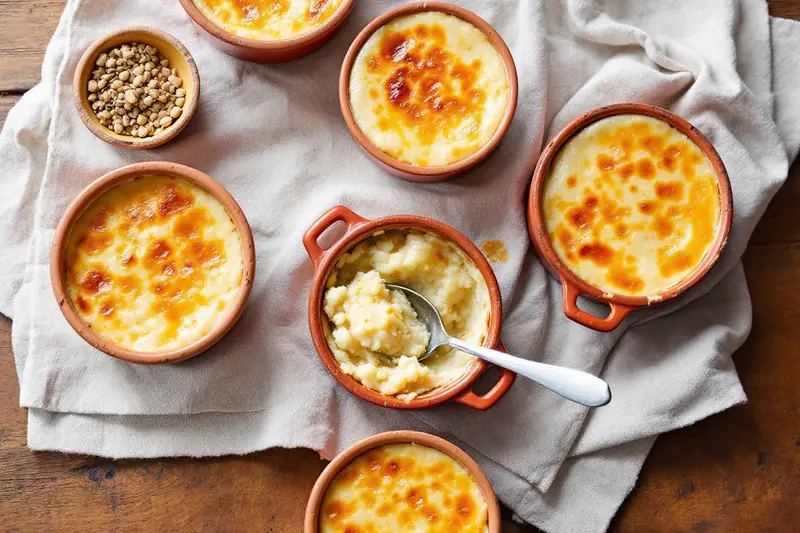
In Istanbul you can still find pudding shops where the sütlaç comes in a little clay bowl with a mottled brown lid of skin on top, cold from the fridge, the rice soft and the milk barely set. Fırın sütlaç means "oven rice pudding", and the oven part is that browned top. Underneath it is a simple pudding of rice, milk and sugar, thickened just enough to hold a spoon's shape. The top is what makes people reach for a second bowl.
I make it at home in Toronto most weekends through the winter, and over the years I have settled on a method that is precise about three things: how much sugar goes in per litre of milk, how thick the pudding is before it goes into the bowls, and how the tops are browned without the pudding boiling underneath. Get those right and the result is consistent, which is the whole reason to write a recipe down.
The three parts of a good sütlaç
Rice cooked in water first
The rice goes into a small amount of water before the milk arrives. Rice cooked straight in milk takes much longer to soften, because the milk proteins and sugar slow down how fast the grains absorb liquid, and the milk is more likely to catch on the bottom of the pan in the meantime. Fifteen minutes in water swells the grains and starts to release their starch. Then the milk goes in.
Use short-grain or medium-grain rice, the kind sold for pudding or for risotto-style dishes. Their starch is what gives sütlaç its creaminess. Long-grain rice stays separate and the pudding tastes like sweet milk with rice in it rather than a pudding.
A little rice flour for body
Rice alone gives a soft, loose pudding. A slurry of rice flour, whisked into cold water and added towards the end, sets it to a texture that holds its shape on the spoon but is still creamy, never rubbery. Rice flour is traditional, gives a clean flavour and has a slightly silkier set than cornflour (cornstarch). If you only have cornflour, use two thirds of the quantity, because it thickens more strongly.
The starch thickens fully only once the pudding comes back to a gentle bubble, somewhere close to 95°C (203°F). If you add the slurry and take the pan off the heat too soon, the pudding sets soft in the fridge and weeps. Stir it for the full eight to ten minutes.
Sugar measured against the milk
I think about sugar as a proportion of the milk, not as a fixed amount. That makes it easy to scale and easy to adjust to your own taste. The recipe below uses 135 g of sugar to a litre of milk, which is sweet enough to taste like a proper pudding but leaves room for the browned milk flavour on top. Older family recipes often used more.
| Sweetness | Sugar per litre of milk | What it tastes like |
|---|---|---|
| Light | 100 g | Milky, clearly a dessert but gentle; good after a heavy meal |
| Standard | 135 g | Balanced; what I make for guests |
| Old-fashioned | 170 g | Rich and sweet, the way it was served in many homes |
Add the sugar after the rice has softened in the milk. Sugar added too early slows the rice down further.
Browning the top without boiling the pudding
This is where most home versions go wrong. The pudding needs a very hot top to blister and brown, but if the pudding itself boils in the bowl it forms bubbles, the texture turns grainy and liquid separates out at the bottom.
The answer is a cold water bath under the grill (broiler). The bowls of hot pudding sit in a deep roasting tin, and cold water is poured into the tin to come halfway up their sides. The grill heats the surface fiercely, while the water around the bowls keeps the body of the pudding cooler. Water in an open tin cannot get hotter than 100°C (212°F), so the bottom half of each bowl stays below boiling while the top colours.
Set your oven to its highest grill setting, or heat it to 230°C (450°F) with the top element on, and put a shelf in the upper third. You want the tops of the bowls about 10 to 12 cm from the element. Too close and they burn in spots before the rest colours; too far and the pudding heats through and boils before the top browns. The tops should be ready in 15 to 20 minutes. Look from ten minutes onwards, and turn the tin if one corner is colouring faster.
What you want to see: a thin skin over the whole surface, blistered, with patches ranging from pale gold to a deep chestnut brown. A few nearly black spots are part of the look. A uniformly pale top means it needs longer; a top that has risen and cracked means the pudding underneath boiled, so next time add more water to the tin or lower the shelf.
Which bowls
Traditional sütlaç bowls are small and made of unglazed or glazed clay, holding about 200 ml. Any ovenproof ramekins or small ceramic bowls of that size work. Glass bowls are fine as long as they are ovenproof and not cold from the fridge when the hot pudding goes in. Metal tins are not a good idea; they conduct heat too quickly and the edges boil.
Fırın sütlaç
Recipe
Fırın sütlaç (baked rice pudding)
6 small bowls, about 200 ml each
- Prep
- 10 min
- Cook
- 1 hr
- Rest
- 5 hr
- Total
- 6 hr 10 min
Pudding
- 1/3 cup65 g short-grain or medium-grain rice, rinsed
- 1 cup240 ml water, for the rice
- 4 1/4 cups1 litre whole milk
- 2/3 cup135 g caster sugar or fine granulated sugar
- 3 tbsp30 g rice flour
- 1/2 cup120 ml cold water, for the rice flour
To serve (optional)
- 1 tsp2 g ground cinnamon
- 2 tbsp15 g finely ground hazelnuts or pistachios
Method
- Put the rinsed rice and 1 cup of water in a heavy-based pan, bring to the boil, then cover and simmer on low for 12 to 15 minutes, until the water is absorbed and the grains are swollen and soft.
- Pour in the milk and bring it up to a gentle simmer over medium heat, stirring often across the bottom of the pan. Simmer for 15 minutes, still stirring every minute or two, until the rice is very soft.
- Add the sugar and stir for 2 minutes, until dissolved.
- Whisk the rice flour into the cold water until smooth. Whisk one ladle of the hot milk into the slurry, then pour it all back into the pan in a thin stream, stirring.
- Cook, stirring constantly, for 8 to 10 minutes, until the pudding bubbles gently and coats the back of a spoon like thin custard. It thickens much more as it cools.
- Heat the grill to its highest setting, or the oven to 230°C (450°F) with the top element on, with a shelf in the upper third.
- Ladle the hot pudding into 6 ovenproof bowls of about 200 ml and stand them in a deep roasting tin. Pour cold water into the tin to come halfway up the sides of the bowls.
- Slide the tin under the grill for 15 to 20 minutes, until the tops are blistered with deep golden and dark brown patches. Check from 10 minutes and turn the tin if needed.
- Lift the bowls out of the water and leave them to cool to room temperature, about 1 hour.
- Chill for at least 4 hours, or overnight, before serving cold, plain or with a dusting of cinnamon or ground nuts.
Cook's notes
- If you only have cornflour (cornstarch), use 2 tbsp (20 g) instead of the rice flour.
- Sütlaç keeps for 3 days in the fridge. Cover the bowls once they are fully cold so condensation does not drip onto the tops.
The thickness test before the bowls
The most useful check comes at step five. Dip a wooden spoon in the pudding, lift it out and draw a finger across the back. If the line stays clean and the pudding does not run back into it, it is ready. On the stove it should look like a loose custard, pourable from the ladle in a thick ribbon. That feels too thin to many people the first time, and they keep cooking. Do not. Sütlaç sets considerably as it chills, and a pudding that already looks set in the pan becomes stiff and claggy in the fridge.
If it runs straight back over the line, give it two or three more minutes of stirring and test again.
Scaling for a crowd
Because everything is a ratio to the milk, scaling is simple arithmetic. For twelve bowls, double everything: 130 g rice, 2 litres of milk, 270 g sugar, 60 g rice flour. Use a wide pan so the milk has room to reduce, and allow an extra five minutes at each simmering stage. Brown the bowls in two batches unless your grill covers the whole tin evenly. The first batch can sit at room temperature while the second browns.
For a single larger dish instead of individual bowls, use a shallow ovenproof dish about 20 by 25 cm, so the pudding is no more than 4 cm deep. A deep dish takes too long to cool in the middle and the top browns unevenly.
Variations
A strip of lemon or orange peel simmered with the milk and lifted out before the sugar goes in gives a fragrant pudding. A small piece of mastic, crushed with a pinch of sugar, is a classic flavouring in some Istanbul homes. Some cooks stir an egg yolk into the slurry, which gives a richer pudding and a deeper brown top. Vanilla is common but not traditional; I leave it out so the browned milk is the main flavour.
Sütlaç without the oven (just poured into bowls and chilled) is called simply sütlaç or tencere sütlacı, and is good in its own right. If you like spooned milk desserts, you may also enjoy aşure, the grain and fruit pudding that is shared with neighbours in some seasons, or a lighter chia seed pudding for breakfast.
Cook's questions
Why is my sütlaç watery at the bottom?
Usually the pudding boiled in the bowls under the grill, or the rice flour was not cooked long enough on the stove. Use more cold water in the tin, and give the pudding the full eight to ten minutes after adding the slurry.
Can I use semi-skimmed milk?
You can, but the pudding is thinner and the top browns less well, because the milk fat helps the skin form and colour. Whole milk is worth it here.
My tops will not brown. What now?
Your grill may be weak or too far away. Raise the shelf a notch and give it five more minutes. If the pudding starts to bubble before the tops colour, take it out; a pale top still tastes good.
How far ahead can I make it?
A day ahead is ideal. The flavour settles and the texture is at its best after a night in the fridge. It is a natural choice for a festive table such as an iftar evening, because it is finished long before guests arrive.
Serving
Serve it cold, straight from the fridge, in the bowls it was baked in. Put the cinnamon and the ground nuts on the table in small dishes for those who want them; I prefer mine plain, so the first spoonful breaks through the dark spots on the skin into the cold white pudding underneath. More sweets and milk puddings are gathered in the sweets and puddings section.
Filed under Desserts

Defne grew up in Istanbul and bakes in Toronto. She writes about milk puddings, syrupy sweets, pastry and festive tables, and she is exact about sugar, temperatures and timing.