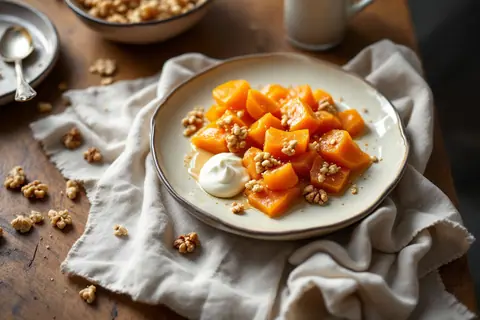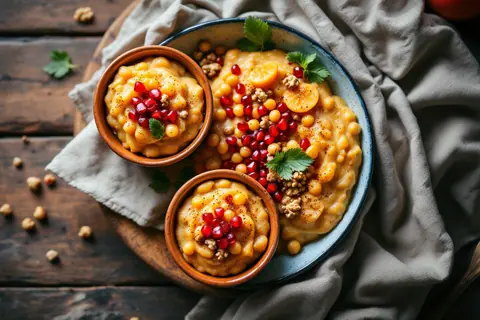

Chia seed pudding with mulberry pekmez, figs and pistachio
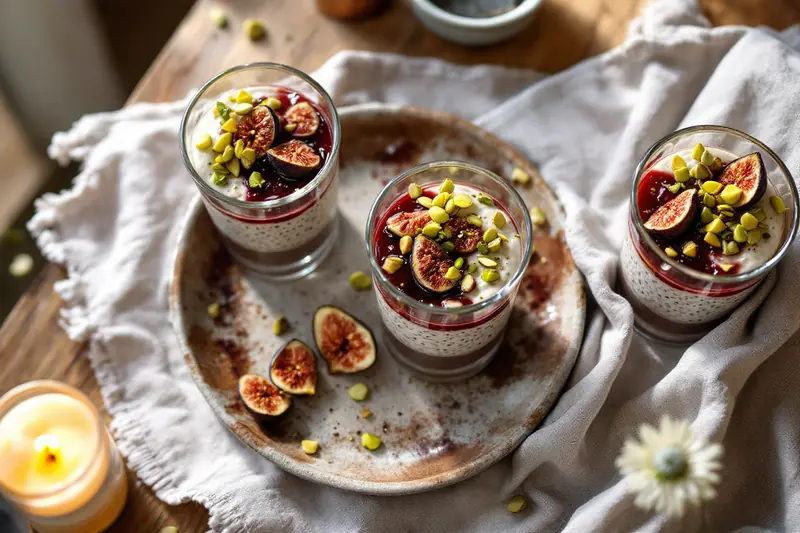
Chia seeds are not Turkish, and I will not pretend otherwise. But the way I like to eat them is very Turkish indeed: set in milk and yogurt, sweetened with pekmez (a thick fruit syrup cooked down from grape or mulberry juice), and topped with figs and pistachios, the same flavours that turn up on a festive tray in Istanbul. The result is a cool, spoonable pudding that needs no stove and no egg, and it waits in the fridge overnight for you.
The appeal is the texture. Each seed grows a soft, clear jacket when it sits in liquid, and together they thicken milk into something between a rice pudding and a set custard. Get the ratio right and it is creamy with a pleasant little pop. Get it wrong and you have either a loose, seedy milk or a dense block you need a knife for.
The ratio that works
I have tested this many times in my own kitchen, and the number I keep coming back to is 3 tablespoons of chia seeds (about 30 g) to 1 cup (240 ml) of liquid. That gives a pudding that holds its shape on a spoon but still slumps gently in the glass. For a firmer set, the sort you can layer cleanly, go to 3 1/2 tablespoons. Below 2 1/2 tablespoons it never quite sets.
A worked example, since I am the kind of cook who weighs everything: for four glasses I use 2 cups (480 ml) of milk and 1/2 cup (120 g) of plain yogurt, which is 600 ml of liquid in all, or two and a half cups. Two and a half times 3 tablespoons is 7 1/2 tablespoons, and I round that down to 6 tablespoons (60 g) because yogurt is already thick and does half the setting work for you. If you make it with milk alone, go back to the full 3 tablespoons per cup.
| Liquid | Chia seeds | Result after 8 hours |
|---|---|---|
| 1 cup milk | 2 tbsp (20 g) | Loose, pourable |
| 1 cup milk | 3 tbsp (30 g) | Soft set, spoonable |
| 1 cup milk | 4 tbsp (40 g) | Firm, slightly dry |
| 3/4 cup milk + 1/4 cup yogurt | 2 1/2 tbsp (25 g) | Soft set, creamy |
Milk, yogurt or both
Whole cow's milk gives the cleanest, richest flavour. Semi-skimmed works but tastes thinner. Adding yogurt brings a gentle sourness that I think the pudding needs, otherwise it can taste flat, the way unsalted rice pudding does. Use a plain, thick yogurt, not a sweetened one, and whisk it into the milk until smooth before the seeds go in.
If you prefer a dairy-free pudding, almond milk is the best of the alternatives I have tried. It is thinner than cow's milk, so use the full 3 tablespoons of seeds per cup, and add the zest of half an orange to give it some body of flavour.
Sweetening with pekmez
Pekmez is where this pudding stops being generic. Mulberry pekmez (dut pekmezi) is dark, almost black, with a winey taste that is less cloying than honey. Grape pekmez is a little lighter and more caramel. Carob pekmez is the most bitter of the three and goes very well with figs.
I use 2 tablespoons of pekmez for four glasses, stirred into the base, plus a teaspoon trickled over each glass at the end. If you have no pekmez, use 1 1/2 tablespoons of honey or 4 teaspoons of caster sugar. Sugar is sweeter per spoon than pekmez, which is why the quantity drops. Taste the milk before the seeds go in: it should taste slightly too sweet, because cold puddings always taste less sweet than their warm base.
Mixing so it does not clump
This is the one step that needs attention. Chia seeds clump the moment they hit liquid, and if you stir once and walk away, you will find a thick knot of seeds at the bottom and thin milk on top.
Whisk the seeds into the milk mixture for a full 30 seconds. Leave it for 10 minutes. Whisk again, scraping the bottom of the bowl, for another 30 seconds. By now the liquid will look slightly thickened and the seeds will be evenly suspended. Then cover and chill for at least 6 hours, ideally overnight. A third stir after an hour in the fridge does no harm if you are still awake.
Preparing the figs
In December fresh figs are long gone, so I use soft dried figs. Snip off the hard stems, cut each fig into quarters, and pour over just enough boiling water to cover, with a strip of orange peel if you have one. After 15 minutes they plump up and turn glossy. Drain them, and keep a spoonful of the soaking water to loosen the pekmez for drizzling. In late summer, use ripe fresh figs, simply quartered.
Pistachios should be shelled, unsalted and chopped by hand to the size of lentils. The bright green Antep pistachios look best, but any unsalted kind is fine. Toast them in a dry pan for 2 minutes if they taste stale.
Recipe
Chia seed pudding with mulberry pekmez, figs and pistachio
4 small glasses
- Prep
- 20 min
- Cook
- 0 min
- Rest
- 8 hr
- Total
- 8 hr 20 min
Pudding
- 2 cups480 ml whole milk
- 1/2 cup120 g plain thick yogurt
- 2 tbsp40 g mulberry pekmez (or 1 1/2 tbsp honey)
- 1/4 tsp1 ml vanilla extract
- 1 pinch1 pinch fine salt
- 6 tbsp60 g chia seeds
Layers and topping
- 88 soft dried figs (or 4 ripe fresh figs)
- 1 strip1 strip orange peel
- 4 tsp25 g mulberry pekmez, for drizzling
- 3 tbsp25 g unsalted pistachios, chopped
Method
- Whisk the milk, yogurt, 2 tbsp pekmez, vanilla and salt in a bowl until smooth; taste it, it should be slightly sweeter than you want the pudding.
- Sprinkle in the chia seeds and whisk steadily for 30 seconds so they are spread through the liquid.
- Leave the bowl for 10 minutes, then whisk again for 30 seconds, scraping the bottom where the seeds settle.
- Cover and chill for at least 6 hours, or overnight, until the pudding holds a soft shape on a spoon.
- Snip the stems from the dried figs, quarter them, cover with boiling water and the orange peel and leave for 15 minutes until plump; drain and keep 1 tbsp of the water.
- Loosen the 4 tsp pekmez with the reserved fig water so it pours easily.
- Stir the set pudding once, then spoon half into four small glasses, add a layer of figs and a little pekmez, and top with the rest of the pudding.
- Finish each glass with a few fig pieces, a thin trickle of pekmez and the chopped pistachios just before serving.
Cook's notes
- The plain set pudding keeps for 3 days in a covered bowl in the fridge; add the figs and pistachios on the day you eat it.
- For a firmer pudding that layers with sharp lines, use 7 tbsp (70 g) chia seeds.
Variations through the year
The base is a canvas, and the Turkish fruit calendar gives plenty to work with. In early summer, use chopped sour cherries cooked for 5 minutes with a spoonful of sugar. In autumn, grated quince poached in a little syrup is very good, and so are pomegranate seeds scattered on top with a few drops of rose water stirred into the base. In winter, apart from figs, I like soft dried apricots soaked the same way, with chopped walnuts instead of pistachios and grape pekmez instead of mulberry.
For a version closer to a classic milk pudding, stir a pinch of ground cinnamon into the base and top with toasted desiccated coconut and hazelnuts. It is not traditional, but it sits comfortably next to a bowl of sütlaç on the same table.
Cook's questions
Can I serve it warm?
You can warm the set pudding gently in a pan with a splash of milk, stirring, for 2 to 3 minutes. Do not let it boil. It becomes looser, almost like a thin porridge, and is pleasant on a cold morning.
Why is mine runny after a night in the fridge?
Usually too much liquid for the seeds, or a missed second stir that left the seeds clumped at the bottom. Stir in another tablespoon of seeds, wait 30 minutes, and it will thicken.
Can I blend it smooth?
Yes. Blitz the set pudding for 30 seconds in a blender and it turns into a dense, mousse-like cream with flecks. Children who dislike the seeds often like this version.
Does it suit a festive table?
Served in small tea glasses, it makes a good cold dessert next to warm things like aşure, and it can be made the day before, which is worth a great deal when the oven is full.
Filed under Desserts

Defne grew up in Istanbul and bakes in Toronto. She writes about milk puddings, syrupy sweets, pastry and festive tables, and she is exact about sugar, temperatures and timing.