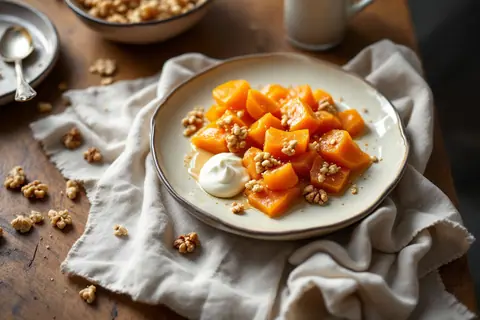

Ayva tatlısı: baked quince halves in ruby syrup with kaymak
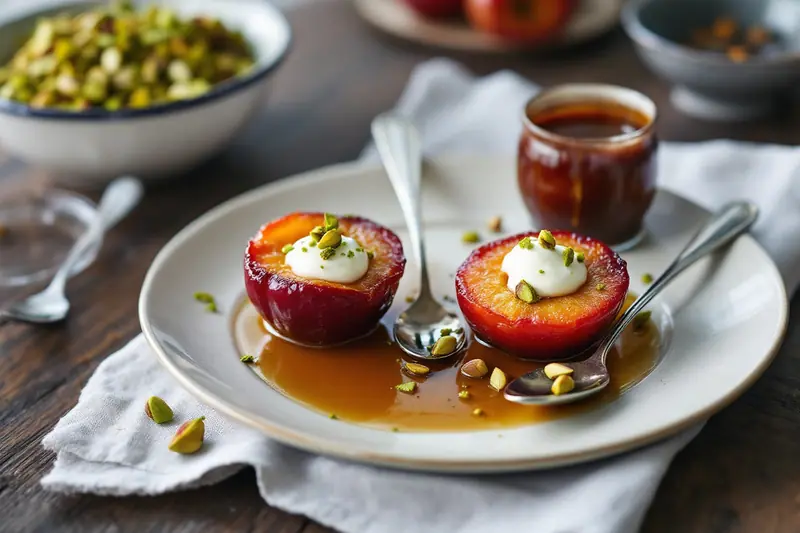
There is a moment in late autumn when the Istanbul fruit stalls smell of quince. The fruit sits in yellow heaps, lumpy and slightly furred, and the scent reaches you before you see them. Raw, a quince is hard, astringent and nearly inedible. Cooked slowly with sugar, it turns soft, fragrant and an astonishing deep red. Ayva tatlısı, quince halves baked in their own syrup and served with a thick spoon of kaymak, is the dessert that makes the wait for quince season worthwhile.
The recipe is short. What takes practice is the colour. A quince cooked too fast stays pale gold; a quince cooked gently for long enough goes through apricot and coral to a deep ruby. The method below is built entirely around getting there, without the fruit collapsing and without the syrup burning.
Choosing quinces
Buy quinces that are mostly yellow, with only a trace of green near the stem, and that smell strongly when you lift them to your nose. They should feel heavy for their size. The grey fuzz on the skin is normal and rubs off under the tap. Small bruises do not matter, as you peel them anyway, but avoid fruit with soft brown patches, which are often brown inside too.
Quinces vary hugely in size. For this recipe you want medium fruit, around 350 to 450 g each, so one half makes a generous serving. Three medium quinces serve six.
If you buy them a little green, leave them in a bowl in the kitchen for a week. They ripen, turn yellow and perfume the whole room.
Preparing the fruit
Quince flesh is dense and hard, so use a heavy, sharp knife and a steady board. Cut each quince in half from stem to base. Peel the halves with a vegetable peeler, then scoop out the core with a sturdy teaspoon or a melon baller, making a neat round hollow. Rub the cut surfaces with lemon as you go, because quince browns quickly.
Do not throw away the peel or the seeds. They are part of the recipe.
The seeds and peel: where the colour and set come from
The seeds of a quince are wrapped in a sticky, almost jelly-like coating. That coating is rich in pectin, the same thing that sets jam. When you cook the seeds alongside the fruit, it thickens the syrup naturally, giving it a soft, glossy body without any extra sugar. The peel carries much of the fruit's perfume and also helps the colour along.
As for the red: quince contains compounds that, with long, gentle heat and a little acid, slowly change into red pigments. You cannot hurry it. High heat cooks the fruit through before the colour has time to develop. Low, covered heat, followed by a period uncovered while you baste, gives you that ruby finish.
I tie the seeds and peel loosely in a square of muslin so they are easy to lift out, but scattering them around the fruit works just as well. Lift them out before serving and discard them.
Sugar: how much and where
Every Turkish cook has a different amount. I use 100 g of sugar per medium quince, so 300 g for three. That gives a syrup sweet enough to keep the fruit for several days and thick enough to coat it, while the fruit still tastes of quince.
The sugar goes into the hollows where the cores were. As the quince cooks, the sugar melts into the fruit from the inside and runs out into the syrup. The halves get an even sweetness right through rather than only on the surface. Any sugar that does not fit in the hollows goes into the water around the fruit.
The colour stages: what to look for
This is the stage-by-stage check I use when baking at 180°C (350°F). Timings are for medium quinces; small ones go a little faster.
| Time in the oven | Colour | Texture |
|---|---|---|
| 30 minutes, covered | Pale gold | Still firm, a skewer meets resistance |
| 60 minutes, covered | Apricot | Tender at the edges, firm at the centre |
| 80 minutes, uncovered and basted | Coral | Tender throughout |
| 100 minutes, uncovered and basted | Deep ruby | Soft but holding its shape, syrup thick |
If the colour is right but the syrup is still thin, lift the fruit onto a plate and boil the syrup on the hob for a few minutes. If the syrup is thickening too fast but the fruit is still pale, add a little hot water and keep going. Write down your timings; next autumn you will know your oven and your quinces.
Recipe
Ayva tatlısı (baked quince with kaymak)
6 quince halves, serves 6
- Prep
- 20 min
- Cook
- 1 hr 40 min
- Rest
- 1 hr
- Total
- 3 hr
Quince
- 3 medium3 medium quinces, about 1.2 kg in total
- 1/21/2 lemon
- 1 1/2 cups300 g granulated sugar
- 2 cups480 ml water
- 44 whole cloves
- 11 cinnamon stick (optional)
To serve
- 6 tbsp120 g kaymak or clotted cream
- 1/4 cup30 g unsalted pistachios or walnuts, finely crushed
Method
- Heat the oven to 180°C (350°F).
- Halve the quinces from stem to base, peel them and scoop out the cores, rubbing the cut faces with the lemon as you work; keep the peel and seeds.
- Lay the halves cut side up in a snug ovenproof dish and fill each hollow with sugar, scattering the rest around them.
- Pour the water around the fruit, add the cloves and cinnamon, and tuck the peel and seeds around the halves or tie them in muslin.
- Cover tightly with foil and bake for 60 minutes, until the edges are tender and the fruit is apricot coloured.
- Remove the foil, spoon the syrup over the fruit and bake uncovered for 30 to 40 minutes more, basting every 10 minutes, until the halves are deep red and the syrup coats a spoon.
- Lift out the peel, seeds and spices and leave the quince to cool completely in its syrup, at least 1 hour.
- Serve at room temperature or chilled, each half topped with kaymak, a spoon of syrup and crushed pistachios.
Cook's notes
- For a stovetop version, cook the halves in a wide covered pan on the lowest heat for 70 minutes, then uncover and baste for 20 to 30 minutes.
- If the syrup starts to darken at the edges before the fruit is red, add 60 ml hot water.
Kaymak and what to use instead
Kaymak is the thick, rich cream skimmed from slowly heated milk, sold in Turkey in rolls and slabs. It is the classic topping, cool and mild against the dense, sweet fruit. Outside Turkey it is hard to find, and clotted cream is the closest substitute: the texture is almost identical and the taste very similar. Mascarpone works too, slightly softened. Thick strained yogurt is not traditional, but its sharpness suits the fruit, and I often serve it that way on ordinary evenings.
For the nuts, finely crushed pistachios are the prettiest against the red. Walnuts are what many homes use, and they are just as good.
Variations
Stovetop in a wide pan
If your oven is busy, the fruit cooks beautifully on the hob in a wide, heavy pan with a lid. Keep the heat at the very lowest setting so the syrup barely trembles, and allow a little longer than in the oven. Turn the halves once, gently, halfway through.
Quince in slices
For a buffet or a large table, cut the peeled quince into thick wedges instead of halves. They cook faster, about 60 to 70 minutes in total, and are easier to serve in small portions. Arrange them on a platter in their syrup and let people help themselves.
With a few drops of rose water
A teaspoon of rose water stirred into the syrup after cooking gives a soft, old-fashioned perfume. Add it only once the fruit is off the heat.
Scaling for a crowd
The recipe scales simply because everything hangs on the number of quinces. Per medium quince you need 100 g sugar, 160 ml water and a clove or two. For a table of twelve, that is six quinces, 600 g sugar and about 950 ml water.
The limit is the dish, not the arithmetic. The halves must sit in a single layer, close together but not stacked, with the water reaching about a third of the way up their sides. Six quinces need two standard roasting dishes or one large tray. If you use two dishes, swap their shelves halfway through the covered stage, because the top of most home ovens runs hotter. Expect the larger batch to need 10 to 15 minutes longer to reach the deep red, since there is more liquid to reduce.
Troubleshooting
- Pale fruit after the full time: the oven ran cool or the dish was too deep. Give it another 20 to 30 minutes uncovered, basting, and next time use a shallower dish.
- Collapsed halves: the fruit was very ripe or the heat too high. They still taste wonderful; serve them in bowls.
- Syrup too thick or sticky once cold: warm the dish gently with a few tablespoons of water and stir.
- Gritty texture: some quinces have small hard cells near the core. Scoop the core a little more generously next time.
Cook's questions
Can I eat the quince seeds?
No. Cook them for their pectin, then lift them out and throw them away.
Why is my quince orange rather than red?
It needed more time at a gentle heat. Colour comes last, after the fruit is already tender, so keep basting.
Can I use less sugar?
You can go down to about 70 g per quince, but the syrup will be thinner and the fruit keeps only two or three days.
Storing and serving ahead
Ayva tatlısı keeps for four days in the fridge, covered, in its syrup. The colour often deepens a little overnight. I like to take it out of the fridge an hour before serving so the syrup loosens and the fruit tastes of more.
It is a natural ending for a long autumn meal, and it pairs well with other milk and grain sweets on a festive table. Set it beside aşure or a tray of baked sütlaç and you have three very different spoonfuls. For more ideas from the same shelf, the sweets and puddings section collects the rest. Serve with small glasses of strong black tea, and keep the leftover syrup: a spoonful stirred into plain yogurt the next morning is the cook's reward.
Filed under Desserts, Seasonal Table

Defne grew up in Istanbul and bakes in Toronto. She writes about milk puddings, syrupy sweets, pastry and festive tables, and she is exact about sugar, temperatures and timing.